

Bringing parents or grandparents to Canada can be exciting, but choosing the right immigration document can sometimes be confusing. Many families come across three options: the Super Visa, Visitor Visa (TRV), and Electronic Travel Authorization (eTA).
Although all three can allow eligible travellers to visit Canada, they are designed for different situations. The Super Visa is specifically for parents and grandparents of Canadian citizens or permanent residents and allows much longer stays. A visitor visa is the standard temporary visa for people who need a visa to visit Canada, while an eTA is generally used by eligible visa-exempt travellers flying to Canada.
With Canada’s immigration rules changing in 2026, it is important to understand the differences before applying.
What Has Changed With the Parents and Grandparents Program in 2026?
The Parents and Grandparents Program (PGP) is a permanent residence pathway, but it is currently paused.
IRCC paused the PGP on July 15, 2026, and is not currently accepting new applications or new interest-to-sponsor forms. Existing applications will continue to be processed, but IRCC has not announced a new intake date.
This makes temporary options such as the Super Visa, Visitor Visa, and eTA particularly relevant for families who want their parents or grandparents to visit Canada.
It is important to remember that none of these three options provides permanent residence by itself.
What Is a Super Visa?
The Super Visa is a temporary resident visa specifically designed for parents and grandparents of Canadian citizens or permanent residents.
One of its biggest advantages is the length of stay. Parents and grandparents entering Canada on a Super Visa can generally stay for up to 5 years at a time. The visa can also allow multiple entries for up to 10 years, depending on the validity of the passport and other circumstances.
To qualify, the applicant generally needs to:
The Canadian host must also meet the applicable financial requirement. A spouse or common-law partner may be able to co-sign the invitation and provide financial support where permitted.
Super Visa Income Rules Changed in 2026
One important update for 2026 concerns how the Super Visa income requirement is calculated.
Starting March 31, 2026, IRCC changed the way family income is considered for Super Visa applications. Under the updated rules, the host can meet the income requirement using income from either of the two taxation years immediately preceding the application, subject to the applicable requirements.
In certain circumstances, the income of the visiting parent or grandparent can also help meet the minimum required amount if the host’s income alone is not sufficient.
Because income thresholds can change, applicants should always check the latest IRCC figures before submitting an application.
Super Visa Medical Insurance
Super Visa applicants must have private health insurance that meets IRCC’s requirements.
The policy must generally provide at least $100,000 in emergency medical coverage and be valid for at least one year from the date of entry into Canada.
Since January 2025, certain policies issued by approved foreign insurance companies can also qualify if they meet Canada’s requirements.
What Is a Visitor Visa?
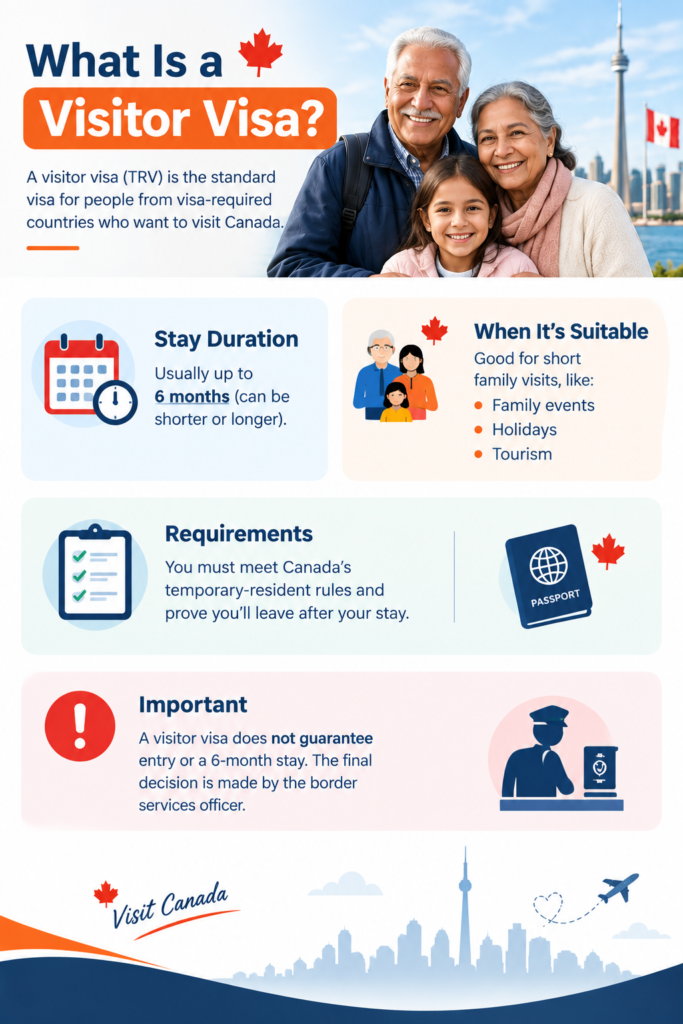
A visitor visa, officially called a temporary resident visa (TRV), is the standard visa used by people from visa-required countries who want to visit Canada temporarily.
Parents and grandparents can apply for a visitor visa without using the Super Visa program.
Most visitors are normally allowed to stay in Canada for up to 6 months, although a border services officer can authorize a shorter or longer period depending on the circumstances.
A visitor visa may be suitable when the purpose is a relatively short family visit, such as
Applicants still need to satisfy Canada’s temporary-resident requirements. This includes convincing the immigration officer that they meet the requirements to enter Canada and will leave when their authorized stay ends.
A visitor visa does not automatically guarantee entry or a six-month stay. The final decision at the border is made by the border services officer.
Can a Visitor Stay Longer Than 6 Months?
If a visitor wants to remain in Canada beyond their authorized stay, they may be able to apply for a visitor record to extend their stay.
A visitor record is different from a visa. It is a document that can allow someone already in Canada to remain longer as a visitor. IRCC recommends applying for an extension before the current authorized stay expires.
An extension is not automatic, so applicants should provide appropriate information and supporting documents explaining why they need additional time in Canada.
What Is an eTA?
An Electronic Travel Authorization (eTA) is not a visa.
It is an electronic travel authorization used by eligible travellers who are normally visa-exempt and are flying to or transiting through a Canadian airport.
The eTA is electronically linked to the traveller’s passport. Travellers must use the passport associated with their eTA when travelling to Canada.
Most eligible visitors can normally stay in Canada for up to 6 months, although the border officer can determine the actual authorized period.
Some citizens of countries that normally require a visa may also qualify for an eTA under specific conditions. For example, certain travellers may qualify if they previously held a Canadian visitor visa within the last 10 years or currently hold a valid U.S. non-immigrant visa and meet the other eligibility requirements.
Therefore, nationality alone is not always enough to determine whether someone needs an eTA or visitor visa.
Super Visa vs. Visitor Visa vs. eTA
| Feature | Super Visa | Visitor Visa | eTA |
| Designed specifically for parents/grandparents | Yes. | No | No |
| Typical stay | Up to 5 years per entry | Usually up to 6 months | Usually up to 6 months |
| Multiple entry | Yes, subject to visa validity. | May be multiple-entry | Yes, while valid |
| Host income requirement | Yes. | No Super Visa income requirement | No |
| Private medical insurance | Required | Not generally required by the visa rules | Not generally required by eTA rules |
| Medical exam | Required for Super Visa applicants | May be required depending on circumstances | Generally not part of the eTA application |
| Leads directly to PR | No | No | No |
| Who needs it | Eligible parents/grandparents | Visa-required travelers | Eligible visa-exempt/eTA travelers |
Which Option Is Right for Parents and Grandparents?
The answer depends mainly on the traveller’s nationality, purpose of travel, and intended length of stay.
Choose a Super Visa when:
A parent or grandparent wants to spend an extended period with family in Canada. The Super Visa is specifically designed for parents and grandparents and allows eligible holders to stay for up to five years at a time.
Consider a visitor visa when:
The parent or grandparent is from a visa-required country and plans to make a temporary visit. The application focuses on the applicant’s purpose of travel, financial circumstances, ties outside Canada, and ability to satisfy temporary-resident requirements.
Consider an eTA when:
The traveller is eligible for an eTA and is travelling to Canada by air for a temporary visit. It is important to check the specific eTA eligibility rules because not every foreign national qualifies.
Can a Parent Have a Super Visa and eTA?
Yes, in certain circumstances.
A parent or grandparent who qualifies for a Super Visa but is from a visa-exempt country may still need an eTA when travelling to Canada by air.
IRCC specifically explains that visa-exempt Super Visa holders may need to apply separately for an eTA, which is electronically connected to their passport.
This is why families should check both the Super Visa requirements and the traveller’s entry requirements before booking travel.
Need Help With Your Canada Visa Application?
Choosing between a Super Visa, Visitor Visa, or eTA can depend on your family situation, travel purpose, nationality, and eligibility. If you are unsure which option is suitable for your parents or grandparents, Rajveer Chahal Education Consultant can help you understand the requirements and prepare your application.
Our team provides guidance with Canada visitor visas, Super Visa, documentation, application preparation, and eligibility assessment. Get professional guidance before submitting your application.
Contact Rajveer Chahal, Education Consultant, today for Canada visa guidance.
Final Thoughts
For parents and grandparents planning a short family visit, a visitor visa or eTA may be appropriate depending on their nationality and travel circumstances.
For families looking for longer visits, the Super Visa provides a specific temporary pathway for parents and grandparents, with eligible holders able to stay for up to five years at a time. It also has additional requirements, including financial support, medical examination, and private health insurance.
With the Parents and Grandparents Program currently paused, many families are looking at temporary options while waiting for further announcements from IRCC. However, a Super Visa, visitor visa, or eTA should not be treated as a guaranteed pathway to permanent residence.
Before applying, check the latest information on Canada.ca because immigration requirements, income thresholds, and application procedures can change.
Frequently Asked Questions
Q1. Is the Parents and Grandparents Program open in 2026?
No. IRCC paused new PGP intake effective January 1, 2026, and reaffirmed that pause in a formal notice on July 15, 2026. No new interest to sponsor forms or invitations is being accepted, and no reopening date has been announced. Applications already in the system are still being processed.
Q2. Does the Super Visa lead to permanent residence?
No. The Super Visa is strictly a temporary resident visa. It lets a parent or grandparent stay for extended periods, but it does not convert into PR status on its own — that only happens through a separate program like the PGP.
Q3. How long can someone actually stay on a Super Visa?
Up to 5 years per entry, and the visa itself can remain valid for up to 10 years (or until the passport expires, whichever comes first).
Q4. Did the Super Visa income requirement change recently?
Yes. Starting March 31, 2026, hosts can meet the income requirement using either of the two most recent tax years (instead of only the year immediately prior), and in some cases the visiting parent or grandparent’s own income can help close the gap once the host meets a minimum portion of the threshold. IRCC has not yet published the exact minimum percentage required.
Q5. Can I extend a stay on a visitor visa or eTA past 6 months?
A visitor visa stay can potentially be extended by applying for a visitor record before your current authorized stay expires—but it’s discretionary, not automatic. An eTA doesn’t work this way; it’s meant for short trips and isn’t designed for long-term extension.
Q6. Does a parent need both a Super Visa and an eTA?
Sometimes, yes. If your parent or grandparent holds a Super Visa but is from a visa-exempt country and is flying to Canada, they may still need a separate eTA linked to their passport. Always check both documents before booking travel.
Q7. Which option is cheapest and fastest to get?
The eTA, by far, approval is often issued within minutes for eligible visa-exempt travelers. The Super Visa generally takes the longest to process given the added income, insurance, and medical exam requirements.
Q8. Is private medical insurance required for a visitor visa or eTA?
No—mandatory medical insurance is a Super Visa-specific requirement. It’s not required by the standard visitor visa or eTA rules, though travel insurance is always a good idea regardless of which document is used.
Q9. What happens if PGP reopens while my parent is already in Canada on a Super Visa?
Nothing changes automatically—the Super Visa and PGP are entirely separate processes. If a new PGP intake opens and you want to pursue permanent residence for your parent or grandparent, you’d need to apply through that program separately, regardless of their current visitor status.