

Preparing for a study visa interview can be one of the most important parts of your study-abroad journey. Students are often concerned about what questions an immigration officer may ask and how they should respond.
For Canada, it is important to understand that an interview is not required for every study permit applicant. During processing, IRCC may ask an applicant to attend an interview or provide additional information if required.
If you are asked to attend an interview, your answers should be honest, clear, and consistent with the information in your application. You should be able to explain your academic background, selected course, college or university, finances, study plans, and future goals.
In this guide, we cover common study visa interview questions in 2026 and practical ways to prepare.
Why Are Study Visa Interviews Conducted?
A study permit application is assessed based on several factors. For Canada, applicants generally need to show that they are enrolled at a designated learning institution (DLI), have sufficient funds, meet applicable admissibility requirements, and can satisfy an officer that they will leave Canada when their study permit expires.
An interview, when requested, can give an officer an opportunity to clarify information in the application.
This is why students should not prepare only general answers. They should understand the details of their own application.
15 Common Study Visa Interview Questions in 2026
1. Why Do You Want to Study in Canada?
This is one of the most common questions students should prepare for.
Explain why the Canadian program fits your academic and career objectives. Mention specific features of the program rather than giving a generic answer about Canada.
For example, you could explain how the curriculum, specialization, or practical components relate to your previous education and future career.
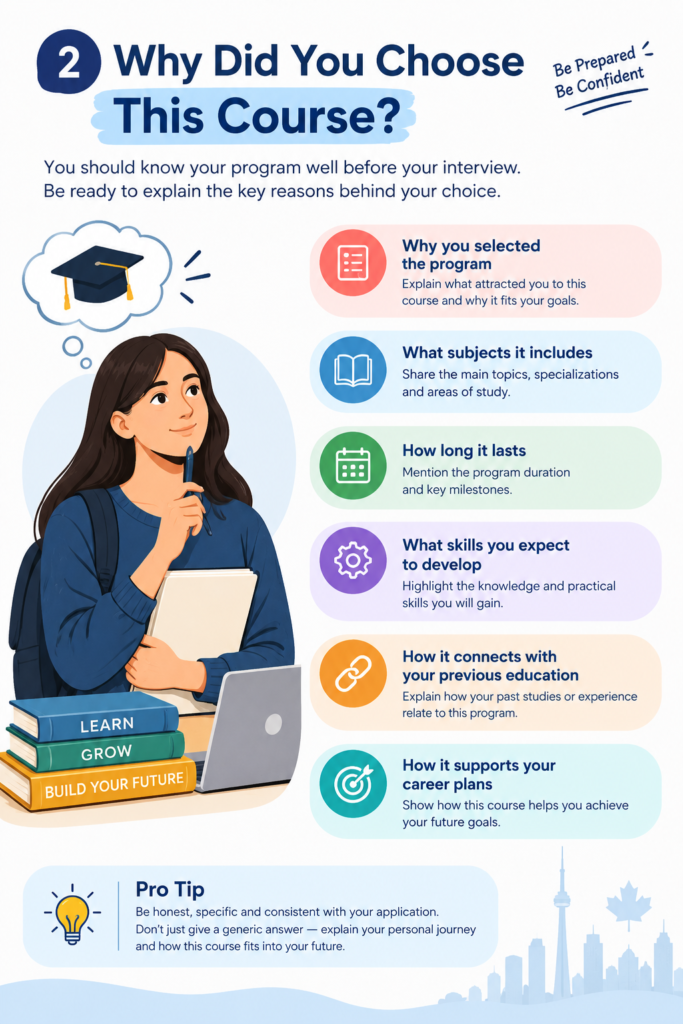
2. Why Did You Choose This Course?
You should know your program well before your interview.
Be prepared to explain:
Your answer should demonstrate that you researched the program before applying.
3. Why Did You Choose This College or University?
An officer may want to know why you selected your particular institution.
Research the institution’s:
Avoid saying that you selected the institution only because an agent recommended it.
Explain the specific reasons that influenced your decision.
4. Why Canada and Not India?
Students should prepare for this question without making negative statements about their home country.
Instead, explain the specific academic reasons behind your choice.
For example, you could discuss a particular specialization, curriculum, practical component, or learning approach that is relevant to your career objectives.
Your answer should create a logical connection between your previous education, the Canadian program, and future career plans.
5. How Is This Course Related to Your Previous Education?
This question is particularly important if your new program is related to your previous studies.
Explain your academic progression clearly.
For example:
Previous qualification → relevant skills → selected program → career objective
If your new program is different from your previous education, explain why you decided to change fields and what influenced that decision.
Do not try to hide a change in academic direction.
6. What Are Your Plans After Graduation?
Prepare a realistic explanation of your career plans.
You can discuss:
For Canadian study permits, applicants must satisfy an officer that they will leave Canada when their study permit expires.
Your answer should therefore be consistent with your overall study plan and application.
7. Who Will Pay for Your Studies?
You should know exactly how your education will be financed.
If your parents are sponsoring you, understand:
If you are self-funded, understand your own financial documents.
IRCC requires students to demonstrate sufficient funds for tuition, living expenses, and transportation without relying on work in Canada to meet the financial requirement.
8. How Much Is Your Tuition Fee?
You should know the tuition amount stated in your documents.
Be prepared to explain:
Do not guess when answering financial questions. Your answers should match your supporting documents.
9. Where Will You Stay in Canada?
You may be asked about your accommodation plans.
Know whether you will stay:
You should also know the general location and how you will travel to your institution.
10. Do You Have Relatives or Friends in Canada?
Always answer this question truthfully.
If you have relatives or friends in Canada, explain the relationship accurately.
Do not provide information that contradicts your application or other documents.
The key is consistency and honesty.
11. What Do You Know About Your Course?
Do not prepare only the course name.
You should know:
IRCC’s document guidance also emphasizes the importance of explaining why you want to study in Canada and understanding your responsibilities as a student.
12. Do You Plan to Work While Studying?
Answer honestly.
Your primary purpose in Canada should be your studies, and you should understand the conditions attached to your study permit.
International students must comply with their study permit conditions, including requirements related to continuing their studies and making progress toward completing their program.
Do not present employment as the primary reason for choosing Canada.
13. What Will You Do If Your Visa Is Refused?
Stay calm when answering this question.
You can explain that you would review the refusal reasons, understand the concerns, and determine the appropriate next step.
If an application is refused, IRCC provides a refusal letter explaining the reasons for the decision.
Avoid suggesting that you would simply submit the same application again without addressing the concerns.
14. Do You Have Any Study Gaps?
If you have a study gap, prepare a straightforward explanation.
A gap could involve:
Explain what you were doing during the period and provide supporting evidence where appropriate.
Do not invent employment or other activities to fill a gap.
15. Why Should Your Study Permit Be Approved?
Keep your response simple.
You can summarize the key aspects of your application:
There is no need for a long speech. A clear and factual answer is usually easier to communicate.
How to Prepare for a Study Visa Interview
Understand Your Application
Read your application carefully before the interview.
Review:
Any important information you provide verbally should be consistent with your application.
Do Not Memorize Your Answers
Memorizing complete paragraphs can make your responses sound unnatural.
Instead, prepare important points for each question.
For example, for “Why did you choose this course?” remember three or four genuine reasons and explain them naturally.
Know Your Financial Situation
Financial preparation is an important part of a Canadian study permit application.
IRCC requires proof of funds for tuition, living expenses, and transportation. For applications made on or after September 1, 2026, the living-expense amount for one applicant outside Quebec is CAD $23,448 per year, excluding tuition and transportation.
For programs longer than one year, applicants must also explain how they plan to finance the full duration of their studies.
Documents You Should Review
Before an interview, review the documents submitted with your application, including:
IRCC’s study permit document requirements include a letter of acceptance from a DLI and, in most cases, a provincial or territorial attestation letter. Quebec applicants generally need a CAQ instead.
Final Study Visa Interview Preparation Checklist
Before your interview, make sure you can confidently answer these questions:
Academic Preparation
Financial Preparation
Career Preparation
Canada Preparation
Expert Guidance for Canada Study Visa Interviews
A successful interview preparation strategy should be based on the student’s actual profile and application, rather than generic memorized answers.
Rajveer Chahal education consultant, provides guidance for students preparing for Canada study permit applications, including profile assessment, documentation, study planning, and interview preparation.
For assistance with your Canada study visa profile:
Rajveer Chahal Education Consultant
Call/WhatsApp: 7068161111 | 7508361111
Frequently Asked Questions
Is a Canada study visa interview mandatory in 2026?
No. IRCC may request an interview or additional information during processing, but not every applicant is required to attend one.
What are the most common study visa interview questions?
Questions commonly focus on your course, institution, reasons for choosing Canada, finances, previous education, study gaps, and future plans.
How should I answer study visa interview questions?
Keep your answers clear, honest, and consistent with your application and supporting documents.
How much money does a student need for Canada in 2026?
For applications submitted on or after September 1, 2026, one student outside Quebec needs to demonstrate CAD $23,448 for annual living expenses, in addition to tuition and transportation costs.
Can I work while studying in Canada?
Some international students may work if they meet the applicable eligibility requirements and study permit conditions. Students must continue complying with their study permit conditions.
Does a study permit guarantee entry into Canada?
No. A study permit and the documents used to enter Canada are different. IRCC explains that an approved study permit application can also result in the required visitor visa or eTA, depending on the passport, while entry is assessed when the student arrives.


