

Planning to bring your spouse to Canada in 2026? Preparing the correct documents is one of the most important steps in a Canadian spousal sponsorship application. Missing information, inconsistent details, or incorrect documents can create delays or result in an incomplete application.
This Spouse Visa Document Checklist 2026 explains the major documents applicants should review, including sponsor documents, identity documents, marriage certificates, relationship proof, police certificates, IRCC forms, translations, medical examinations and biometrics.
It is important to understand that “Canada spouse visa” is a commonly used term. For Canadian immigration purposes, eligible spouses are generally sponsored for permanent residence through Canada’s family sponsorship program.
The exact requirements can vary according to your relationship category, personal circumstances, country of residence and information provided in your application. Therefore, your personalized IRCC checklist should always be checked before submission.
What Is Canada Spousal Sponsorship in 2026?
Canada’s family sponsorship program allows eligible Canadian citizens and permanent residents to sponsor certain family members for permanent residence.
For spouse and partner sponsorship, eligible relationship categories can include:
The sponsor must meet the applicable sponsorship requirements, while the sponsored person must meet Canada’s permanent residence and admissibility requirements.
Therefore, a Canada spouse visa application is not simply about providing a marriage certificate. IRCC reviews the application, supporting documents, relationship information and applicable eligibility and admissibility requirements.
Spouse Visa Document Checklist 2026
The exact documents required depend on your application. However, applicants should review the following major document categories.
1. Sponsor’s Proof of Canadian Status
The sponsor needs to provide evidence of their status in Canada.
Depending on the circumstances, this may include:
The document required depends on the sponsor’s status. Make sure the document is clear and the information matches the application forms.
2. Sponsor’s Identity and Personal Information
The sponsor may need to provide identity and personal information requested by IRCC.
This can include:
Check dates carefully and make sure there are no unexplained gaps in your history.
3. Principal Applicant’s Passport and Identity Documents
The spouse being sponsored should prepare the required identity and travel documents.
These may include:
All copies should be clear and readable.
4. Marriage Certificate
For applicants applying as married spouses, the marriage certificate is an important part of the Canada spouse visa document checklist.
The marriage document should demonstrate the legal marriage and meet the applicable requirements.
Depending on your circumstances, you may also need:
If the document is not in English or French, check IRCC’s translation requirements.
5. Proof of Genuine Relationship
Relationship evidence is an important part of a spousal sponsorship application.
A marriage certificate establishes the legal marriage, but applicants may also need supporting evidence about the history and nature of their relationship.
Depending on your circumstances, evidence may include:
Communication Evidence
Photographs
Travel Evidence
Financial or Shared-Life Evidence
Where applicable:
Family and Social Evidence
This may include:
There is no universal number of photographs or messages that guarantees approval. The evidence should be genuine, relevant and consistent with the information provided in the application.
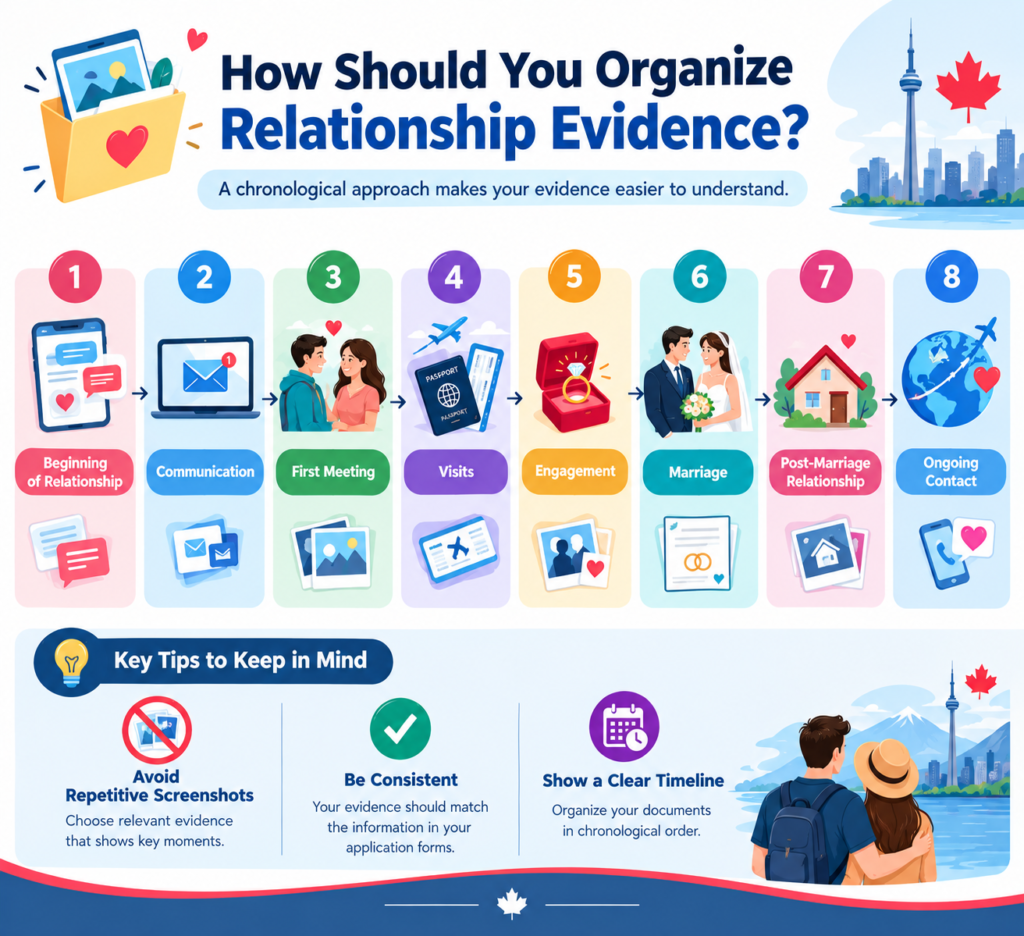
How Should You Organize Relationship Evidence?
A chronological approach can make your evidence easier to understand:
Beginning of relationship → communication → first meeting → visits → engagement → marriage → post-marriage relationship → ongoing contact
Avoid submitting hundreds of repetitive screenshots. Instead, select relevant evidence that demonstrates important stages of your relationship.
Your evidence should also be consistent with your application forms.
6. IRCC Forms for Spousal Sponsorship
Forms are an essential part of the IRCC spouse sponsorship checklist.
Depending on your circumstances, forms can include:
The exact forms required depend on your circumstances.
Always use the latest forms available through IRCC. Do not rely on an old form downloaded from another website.
7. Family Information and Dependent Children
Applicants must provide family information according to IRCC’s requirements.
This can include information about:
Family members must be declared according to the applicable rules, even if they are not accompanying the applicant to Canada.
Depending on the situation, additional documents such as birth certificates, adoption documents or custody documents may be required.
8. Police Certificates
Police certificates may be required as part of the background and admissibility assessment.
The current spouse sponsorship checklist generally requires applicable police certificates for countries other than Canada where the applicant or applicable family members spent six or more consecutive months since the age of 18, subject to IRCC’s instructions.
Requirements can vary according to circumstances and country.
Therefore, applicants should review IRCC’s current police-certificate instructions and country-specific requirements before obtaining or submitting a certificate.
9. Medical Examination
A medical examination may be required during the permanent residence process.
Applicants should follow the medical instructions provided by IRCC and use an approved panel physician when instructed.
Do not automatically assume that every applicant must complete an upfront medical examination before submitting the application. Follow the current IRCC instructions for your application.
10. Biometrics
Biometrics may also be required.
If IRCC requires biometrics, the applicant receives instructions explaining how to provide fingerprints and a photograph.
When you receive a Biometric Instruction Letter, follow the instructions and complete biometrics within the specified timeframe.
11. Photographs
Applicants may need photographs that meet IRCC’s specifications.
Immigration application photographs are different from photographs submitted as relationship evidence.
Make sure your application photographs follow the current IRCC specifications regarding size and other requirements.
12. Translation of Documents
Documents that are not in English or French may require translation according to IRCC’s rules.
This may apply to:
Do not assume that an informal translation is sufficient.
Follow the current IRCC requirements for certified translations and supporting documentation.
13. Country-Specific Documents
One of the most important parts of a Spouse Visa Document Checklist 2026 is checking country-specific requirements.
Depending on where the applicant lives or where a document was issued, IRCC may have specific instructions for:
A checklist prepared for another applicant may therefore not be suitable for your application.
Always check the requirements applicable to your country and circumstances.
Common Canada Spouse Visa Document Mistakes
Applicants can avoid many preparation problems by reviewing their documents carefully.
1. Using an outdated checklist
Immigration forms and requirements can change. Always check the current IRCC information.
2. Missing signatures
Review every applicable form and make sure the required signatures are completed correctly.
3. Inconsistent information
Names, dates, addresses, employment history and relationship details should be consistent across the application.
4. Poor-quality documents
Make sure scans and copies are complete, clear and readable.
5. Missing translations
Documents that are not in English or French may require appropriate translation.
6. Weak relationship evidence
Provide relevant evidence that explains your relationship rather than relying only on the marriage certificate.
7. Too much repetitive evidence
More documents do not automatically mean a stronger application. Focus on relevant evidence.
8. Not declaring family members
Make sure all applicable family members are declared according to IRCC requirements.
9. Ignoring country-specific requirements
Check the instructions for the country where you live and where relevant documents were issued.
10. Not reviewing the complete application
Review every form and supporting document before submission.
How to Organize Your Spouse Sponsorship Documents
A simple structure can make document preparation easier.
Sponsor Documents
Applicant Documents
Marriage Documents
Relationship Evidence
Background Documents
Additional Documents
Final Canada Spouse Visa Checklist 2026
Before submitting your application, review:
Sponsor
☐ Proof of Canadian status
☐ Passport/identity documents
☐ Sponsorship forms
☐ Address history
☐ Employment information where applicable
☐ Other required documents
Sponsored Spouse
☐ Passport/travel document
☐ Birth certificate
☐ Identity documents
☐ Marriage certificate
☐ Previous marriage documents, if applicable
☐ Police certificates, where required
☐ Background forms
☐ Family information
☐ Travel history
Relationship
☐ Wedding photographs
☐ Relationship photographs
☐ Communication evidence
☐ Travel/visit evidence
☐ Shared-life evidence where applicable
☐ Family/social evidence
☐ Other relevant relationship documents
Additional Requirements
☐ Required translations
☐ Country-specific documents
☐ Required photographs
☐ Medical examination when instructed
☐ Biometrics when required
☐ Applicable fees
☐ Payment receipt
☐ Required signatures
☐ Final application review
What Happens If Your Application Is Incomplete?
IRCC checks applications for completeness.
If required information or documents are missing, an application can be returned or rejected as incomplete rather than proceeding normally.
This is why applicants should carefully compare their application against the current IRCC checklist before submission.
If you cannot obtain a required document, do not simply ignore it. Check IRCC’s instructions regarding unavailable documents and provide an explanation and supporting evidence where applicable.
How Rajveer Chahal Education Consultant Can Help
Preparing a Canada spouse visa document checklist 2026 is only one part of the application process.
Rajveer Chahal Education Consultant provides guidance for applicants preparing Canada spouse sponsorship applications, including:
Our team can help applicants understand the documentation process and identify areas that may need attention before submission.
If you are planning to sponsor your spouse to Canada, proper preparation can help you organize your documents more efficiently and avoid common application mistakes.
Frequently Asked Questions
1. What documents are required for a Canada spouse visa in 2026?
Common documents include sponsor status documents, passports, identity and civil-status documents, marriage documents, relationship evidence, applicable police certificates, IRCC forms, translations and other documents requested by IRCC.
2. Is a marriage certificate required?
If you are applying as a married spouse, you generally need evidence of the legal marriage that meets the applicable IRCC requirements.
3. How many photos are required for spouse sponsorship?
The applicable IRCC checklist provides instructions regarding photographs and relationship evidence. There is no universal number of relationship photographs that guarantees approval.
4. How much relationship proof should I provide?
Provide genuine and relevant evidence that demonstrates the history and nature of your relationship. Organize it logically rather than submitting large amounts of repetitive material.
5. Do I need a police certificate?
Police certificates may be required depending on your residence history and circumstances. Check the current IRCC police-certificate requirements for your application.
6. Do documents need to be translated?
Documents that are not in English or French may require translation according to IRCC’s requirements.
7. Is a medical examination required?
A medical examination may be required. Follow the medical instructions provided by IRCC rather than relying on outdated information.
8. Are biometrics required?
Biometrics may be required. If they are required for your application, IRCC will provide instructions for completing the process.
9. Can I use an old spouse visa checklist?
It is better to use the latest IRCC checklist and application instructions. Requirements and forms can change.
10. What happens if I miss a required document?
An incomplete application can be returned or rejected. Review the current IRCC checklist carefully before submission.
11. Can my spouse visit Canada while the sponsorship application is processing?
A sponsored spouse may be able to apply for a temporary resident visa to visit Canada while the permanent residence application is being processed. They must still meet the requirements for temporary entry, and approval is not automatic.
12. Where can I find the official Canada spouse sponsorship checklist?
IRCC provides IMM 5533 – Document Checklist: Spouse (Including Dependent Children) along with the applicable application instructions. Applicants should also check country-specific requirements.
Conclusion
Preparing the correct Spouse Visa Document Checklist 2026 is an important step in a Canada spousal sponsorship application.
The process involves more than a marriage certificate. Applicants may need to provide sponsorship forms, identity documents, civil-status documents, relationship evidence, police certificates, translations and other documents depending on their circumstances.
The most important step is to use the latest IRCC requirements and personalized checklist rather than relying only on a general checklist found online.
If you need assistance preparing your Canada spouse visa documents, Rajveer Chahal Education Consultant can help you understand the documentation process, review your application materials and organize your supporting documents.
Always verify the latest requirements directly with IRCC before submitting your application.


