

Canada’s Spousal Open Work Permit (SOWP) rules have changed significantly in recent years. Since January 21, 2025, spouses and common-law partners of international students and foreign workers are subject to more specific eligibility requirements. In 2026, having a spouse who holds a Canadian study or work permit does not automatically make someone eligible for an open work permit.
For people who are already in Canada, there is another important question: Can the spouse apply for a work permit from inside Canada?
The answer depends on both the applicant’s circumstances and the category under which they are applying.
This guide explains the main Spousal Open Work Permit 2026 rules, including eligibility for spouses of international students and foreign workers, in-Canada application requirements, extensions, and important documentation.
What Is a Spousal Open Work Permit?
An open work permit allows an eligible foreign national to work in Canada without being restricted to one specific employer.
For spouses and common-law partners, eligibility is based on specific immigration circumstances. Depending on the category, the principal applicant may be an international student, a temporary foreign worker, or a person connected to an eligible permanent residence pathway.
An open work permit is different from an employer-specific work permit. An employer-specific permit normally requires a specific job and employer, while an open work permit can allow eligible applicants to work for most employers, subject to the conditions on the permit.
For 2026 applicants, the most important point is that SOWP eligibility must be established under the applicable IRCC category.
Who Can Qualify for a Spousal Open Work Permit in 2026?
There are several situations where a spouse or common-law partner may still qualify.
The two major categories are
There are also separate rules for certain family members connected to permanent residence programs and pathways.
The requirements are not identical in each category.
1. Spouse of an Eligible International Student
The rules for spouses of international students became more restrictive on January 21, 2025.
Under the current IRCC rules, a spouse or common-law partner may qualify where the student has a valid study permit and is:
This means the spouse of every international student does not automatically qualify for a SOWP.
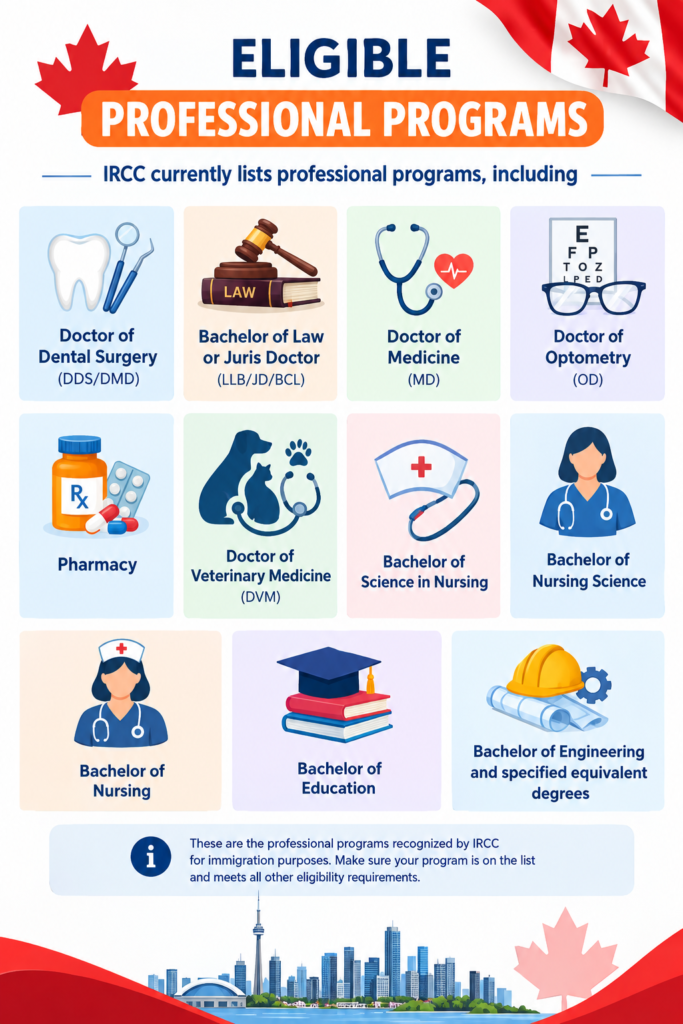
Eligible professional programs
IRCC currently lists professional programs, including
There are also certain specifically eligible programs and pilot programs listed by IRCC.
Therefore, applicants should check the exact program, rather than assuming that a particular level of education automatically qualifies.
2. Spouse of an Eligible Foreign Worker
Spouses and common-law partners of certain foreign workers can also qualify for an open work permit.
However, the current rules are more limited than they were before January 2025.
IRCC states that family open work permits are generally limited to spouses of foreign workers employed in:
The principal applicant’s occupation therefore matters.
It is not enough to simply say that the principal applicant is working in Canada. The applicant should identify the correct occupation and determine whether it falls within the applicable IRCC eligibility requirements.
Why the NOC and TEER Category Matter
Canada uses the National Occupational Classification (NOC) system to classify occupations.
For a SOWP application based on a foreign worker, the principal applicant’s actual job duties and occupation are important.
A spouse should therefore review:
IRCC’s family-member rules contain specific eligibility requirements, so applicants should use the current official occupation list rather than relying on older SOWP information published before the 2025 changes.
Can You Apply for a Spousal Open Work Permit From Inside Canada?
Yes, in certain circumstances.
However, being physically present in Canada does not automatically mean that you can apply for a work permit from inside Canada.
IRCC states that most people cannot apply for a work permit from inside Canada unless they fall into one of the situations specifically listed by IRCC.
A person may be able to apply from inside Canada if, for example:
This distinction is extremely important.
SOWP eligibility vs. in-Canada eligibility
There are effectively two questions:
First: Does the spouse qualify for an open work permit under the applicable SOWP rules?
Second: Is the spouse allowed to submit that work permit application from inside Canada?
Both requirements need to be considered.
What If the Spouse Is in Canada as a Visitor?
This is one of the situations that requires careful attention.
A visitor in Canada does not automatically become eligible for a work permit simply because their spouse has a Canadian study or work permit.
IRCC has specific rules determining who can apply for a work permit from inside Canada.
For some SOWP categories, a spouse already in Canada may qualify if they have valid temporary resident status. IRCC also recognizes certain situations involving maintained status or eligibility for restoration.
Therefore, a visitor should first establish:
The fact that someone is already in Canada is only one part of the assessment.
What Is Maintained Status?
Maintained status can be important for spouses who are already in Canada.
If a person applies to extend their temporary status before their current status expires, they may be able to remain in Canada under maintained status while IRCC processes the application, subject to the applicable rules.
IRCC’s family-member open work permit instructions also recognize applicants in Canada who have:
The exact work authorization available while an application is being processed depends on the applicant’s circumstances and the type of application submitted.
Can an Existing SOWP Be Extended in 2026?
Yes, certain existing SOWP holders may still be able to extend their permits.
IRCC provides specific extension rules for family members already in Canada.
For example, family members in Canada can apply to extend an open work permit after the January 21, 2025, changes if:
The new permit cannot normally extend beyond the expiry of the principal applicant’s work permit or the applicant’s passport or biometric validity, as applicable.
This makes the expiry dates on both permits important when planning an extension.
Spouses Connected to Permanent Residence Pathways
Not all SOWP cases are based on a student’s study permit or a temporary foreign worker’s job.
IRCC also has specific open work permit measures for family members of people progressing through certain permanent residence programs and pathways.
The applicable rules can depend on:
IRCC’s current instructions include special measures for certain economic immigration and provincial pathways. Because these rules can vary between programs, applicants should identify the exact PR pathway before determining SOWP eligibility.
Spouse of a Person Applying for Permanent Residence
A separate situation applies to spouses or common-law partners being sponsored for permanent residence.
For eligible in-Canada family sponsorship cases, a sponsored spouse or common-law partner may be able to apply for an open work permit while the permanent residence application is being processed, provided the applicable requirements are met.
This should not be confused with the SOWP rules for spouses of international students or foreign workers.
The immigration pathway matters because different open work permit categories have different eligibility requirements.
Documents Required for a Spousal Open Work Permit
The exact document checklist depends on the applicant’s circumstances and the questionnaire completed through the IRCC application process.
Documents may include:
Relationship documents
Principal applicant’s documents
Spouse’s documents
For spouses of international students, IRCC specifically refers to evidence such as the student’s valid study permit and proof of enrollment or transcripts, along with evidence of the relationship.
How to Apply From Inside Canada
If you are eligible to apply from inside Canada, the process generally involves:
Step 1: Confirm eligibility
Determine whether you qualify under the applicable SOWP category and whether you can apply from inside Canada.
Step 2: Complete the IRCC questionnaire.
Your answers determine the application type and personalized document checklist.
Step 3: Prepare supporting documents
Upload the documents requested for your specific situation.
Step 4: Pay the required fees
IRCC currently lists the work permit processing fee unless an exemption applies. Additional fees may apply depending on the type of application.
Step 5: Submit the application
Applications from inside Canada are generally submitted online through an IRCC account, subject to limited exceptions.
Step 6: Complete biometrics if required
IRCC will provide instructions if biometrics are required.
Step 7: Wait for a decision.
Processing times can change, so applicants should use IRCC’s current processing-time tool rather than relying on an old processing-time estimate.
What Should You Check Before Applying?
Before submitting a Spousal Open Work Permit 2026 application, review the complete circumstances of both spouses.
The most important information includes:
A correct assessment depends on the specific facts of the case.
Need help assessing your SOWP profile?
Connect with Rajveer Chahal Education Consultant for professional guidance on your spousal open work permit application, eligibility assessment, documentation, and application process.
Call or WhatsApp: 7068161111 | 7508361111
Final Takeaway
The Spousal Open Work Permit 2026 remains available, but the eligibility rules are more targeted than they were before January 21, 2025.
For spouses of international students, eligibility generally depends on whether the student is enrolled in a qualifying master’s, doctoral, professional, or other eligible program.
For spouses of foreign workers, the worker’s occupation and the applicable NOC/TEER category are important, with family open work permits focused on TEER 0 and 1 occupations and selected TEER 2 and 3 occupations under the current rules.
For someone already in Canada, there is an additional consideration: qualifying for a SOWP does not by itself answer whether the person can apply from inside Canada. IRCC has separate requirements for in-Canada work permit applications.
Because IRCC rules and eligible categories can change, applicants should verify their specific situation against the current IRCC requirements before submitting an application.
FAQs
Q1. Can I apply for a spousal open work permit from inside Canada in 2026?
Potentially, yes. You must qualify for an eligible open work permit category and also meet IRCC’s requirements for applying from inside Canada.
Q2. Can the spouse of any international student get a SOWP?
No. Current rules limit eligibility to spouses of students in specified master’s, doctoral, professional, and other eligible programs.
Q3. Does every TEER 2 job qualify for a spousal open work permit?
No. The rules refer to selected TEER 2 and TEER 3 occupations rather than every occupation within those categories.
Q4. Can an existing SOWP be extended?
Certain family members already in Canada can extend their open work permits if they meet IRCC’s specific extension requirements.
Q5. Can a visitor in Canada apply for a SOWP?
It depends on the person’s circumstances. Being in Canada as a visitor does not automatically provide eligibility to apply for a work permit from inside Canada. The applicant must meet both the applicable SOWP requirements and the rules for an in-Canada work permit application.
Q5. Are SOWP rules the same in 2026 as they were before 2025?
No. Significant changes took effect on January 21, 2025, restricting family open work permit eligibility for spouses of international students and foreign workers.


