

Choosing a college in Canada is one of the most important decisions international students make when planning their education abroad. Many students compare tuition fees, admission requirements, course duration, and location. However, one important factor is often overlooked: whether the program they choose can make them eligible for a Post-Graduation Work Permit (PGWP).
Some students assume that if a college is a Designated Learning Institution (DLI), they can automatically apply for a PGWP after graduation. Others believe that receiving a diploma from a public college guarantees eligibility, even when their classes are delivered by a private institution.
Both assumptions can be misleading.
Canada has different types of public and private post-secondary institutions, and PGWP eligibility depends on the institution, the program, the study permit application date, and other immigration requirements. Understanding these differences before paying a tuition deposit can help students make a more informed decision.
In this guide, Rajveer Chahal, an education consultant, explains the key differences between public and private colleges in Canada and the PGWP risks international students should investigate before enrolling.
1. What Is the Difference Between Public and Private Colleges in Canada?
Public and private colleges can both offer post-secondary education, but their ownership, funding, programs, and regulatory arrangements may differ.
| Factor | Public colleges | Private colleges |
| Ownership | Generally publicly funded and operated | Privately owned or operated |
| Tuition fees | Vary by institution and program. | Vary by institution and program. |
| Programs | Diplomas, certificates, degrees, and other qualifications, depending on the institution | Diplomas, certificates, degrees, and other qualifications, depending on authorization |
| International student admission | Depends on program requirements and available spaces. | Depends on program requirements and available spaces. |
| PGWP eligibility | Must still meet applicable institution and program rules | Must be verified carefully for the exact institution and program |
| Student services | Vary by institution and campus. | Vary by institution and campus. |
The key point is that public versus private is not the only factor that determines PGWP eligibility.
A private institution is not automatically ineligible for every PGWP pathway, and studying at a public institution does not mean every program automatically qualifies. The institution’s status and the program’s specific eligibility conditions must be checked against current IRCC rules.
2. The Biggest PGWP Risk: Public-Private College Partnerships
One of the most important issues international students need to understand is the public-private curriculum licensing arrangement.
Under this type of arrangement, a public college allows a private college to deliver its curriculum. Students may attend classes at a private campus while receiving a qualification associated with the public institution.
This can create confusion. A student might see the name of a recognized public college on the program information and assume that the course qualifies for a PGWP.
However, IRCC introduced restrictions on these arrangements.
Students who began a program delivered through a public-private curriculum licensing arrangement on or after May 15, 2024, are generally not eligible for a PGWP under this program pathway. A limited transitional exception applies to qualifying students who began certain programs in the same province on or before May 15, 2024, subject to all other eligibility requirements.
This means you should not choose a college based only on the name printed on your diploma or the institution associated with your course.
Before enrolling, confirm:
If a college representative says, “You will receive a public college diploma, so you will get a PGWP,” ask for the precise program reputation and details and independently verify the claim.
A diploma, a public college’s reputation, and a DLI listing do not replace the immigration eligibility requirements.
3. Is Every Public College Programme Eligible for a PGWP?
No. This is another important distinction.
Graduating from a public college does not automatically make every student eligible for a PGWP. IRCC requires graduates to meet the applicable general, program-specific, and other eligibility conditions.
Depending on the circumstances, these may include:
The eligibility assessment can depend on when the student applied for their study permit, not merely when they graduate.
For example, two students could attend the same college but have different outcomes if their programs or applicable immigration requirements differ.
This is why students should verify the exact program before accepting an offer rather than relying only on general statements about the institution.
4. The Field-of-Study Requirement Can Affect College Graduates
Even if a college and program meet the relevant institutional requirements, some graduates must also satisfy the PGWP field-of-study requirement.
For students in non-degree programs, such as many college diploma and certificate programs, the field-of-study rules depend on the date they applied for their study permit and whether an exception applies.
For example, students who applied for their study permit on or after November 1, 2024, generally need to graduate from an eligible field of study if they are completing a non-degree program, subject to the applicable exceptions. Bachelor’s, master’s, and doctoral degree graduates are exempt from this particular field-of-study requirement, although other PGWP conditions still apply.
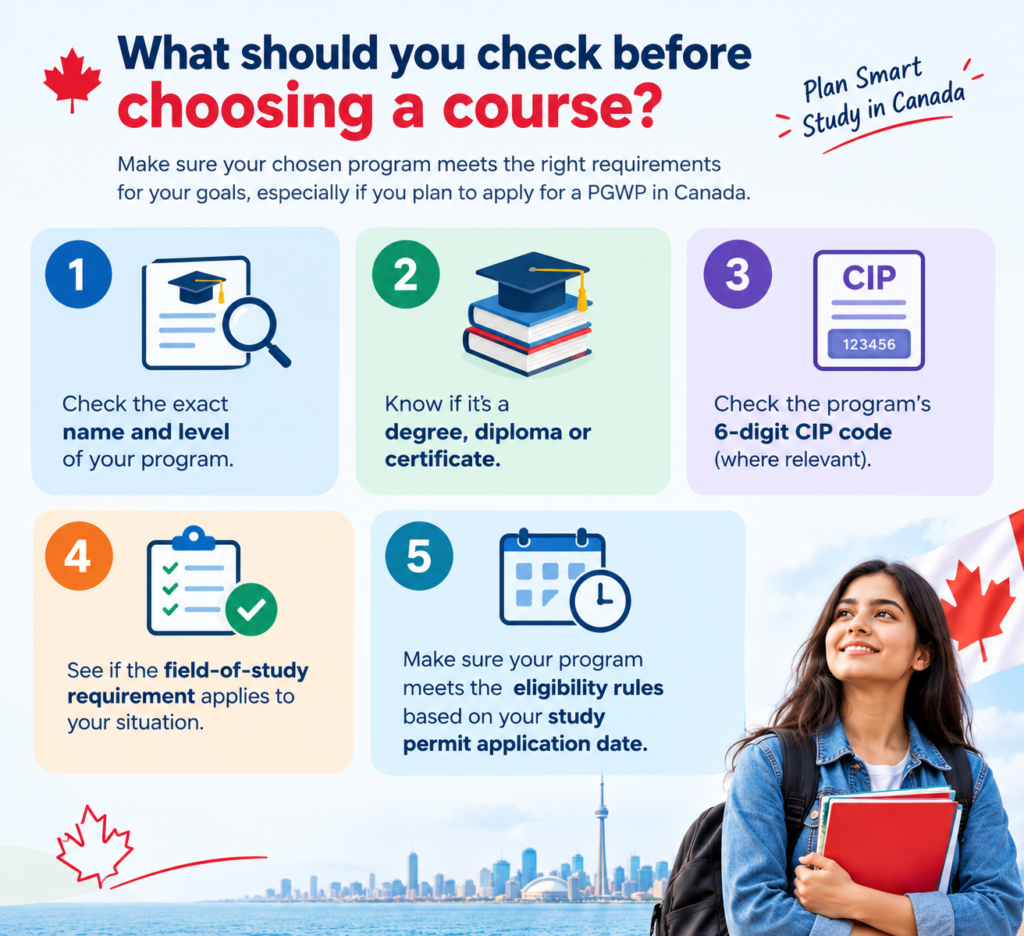
What should you check before choosing a course?
IRCC’s published guidance states that the eligible field-of-study list is frozen for 2026, meaning no eligible fields will be added or removed during that year under the announced policy. Nevertheless, students should verify their particular program against the official list and applicable rules.
5. Does a Private College Automatically Mean No PGWP?
No. It is important to distinguish between private colleges operating under different legal and educational arrangements.
Some private institutions offer programs that do not qualify for a PGWP, while certain private degree-granting institutions may offer eligible programs under the applicable rules.
The important question is not simply whether an institution is privately owned. You need to verify the institution’s status, the specific program, and the applicable PGWP conditions.
Before making a decision, check the following:
| What to verify | Why it matters |
| DLI status | Confirms whether the institution is designated to host international students |
| PGWP eligibility | Helps establish whether the institution and program meet the relevant requirements. Program |
| Program type | Degree and non-degree programs can have different conditions. |
| Delivery arrangement | A public-private curriculum licensing arrangement can affect eligibility. |
| Field of study | Certain non-degree programs must meet the field-of-study requirement. |
| Language requirement | Most applicants need to provide evidence of English or French ability when applying for a PGWP. |
Do not rely solely on a college advertisement, an education agent’s verbal assurance, or a statement that a program is “PGWP-friendly.” Verify the details independently.
6. How Long Can You Work in Canada After Graduation?
The length of a PGWP depends on the eligible program, its duration, the qualification earned, and other applicable conditions.
Generally:
These are general rules, not guarantees. Passport validity and other eligibility conditions can affect the permit issued.
Remember that being eligible for a PGWP does not guarantee permanent residence in Canada. A PGWP may provide an opportunity to gain Canadian work experience, but permanent residence has separate eligibility criteria and selection processes.
8. How Rajveer Chahal, Education Consultant, Can Help
Choosing a Canadian college requires more than comparing tuition fees or selecting the program with the fastest admission process. Students should consider their academic background, career plans, budget, and long-term immigration goals together.
At Rajveer Chahal Education Consultant (RCEC), students can seek guidance on Canadian college selection, program assessment, admission documentation, and study permit preparation.
Before finalizing your admission, it is worth reviewing whether the program matches your educational goals and whether you have checked the relevant PGWP requirements. This can help you make a more informed decision before committing to tuition fees.
For guidance, visit Rajveer Chahal Education Consultant or contact the team at 7068161111 or 7508361111.
Immigration eligibility depends on the rules applicable to your individual circumstances. No institution or consultant can guarantee a PGWP or permanent residence outcome.
Frequently Asked Questions
Q1. Is a public college better than a private college in Canada for PGWP?
Ans. Neither label alone determines eligibility. You must check the institution, program, delivery arrangement, and applicable IRCC requirements before enrolling.
Q2. Can I get a PGWP if I study at a private college in Canada?
Ans. It depends on the institution and program. Some private-college programs are not eligible, including most programs delivered through public-private curriculum licensing arrangements that fall under IRCC’s restrictions. Verify the exact program before accepting an offer.
Q3. Does a public college diploma guarantee a PGWP?
Ans. No. A public college diploma does not automatically guarantee eligibility. Graduates must meet all applicable PGWP requirements, including program-specific conditions.
Q4. What is the public-private partnership PGWP rule?
Ans. In general, students who began a program delivered by a private college on behalf of a public college under a curriculum licensing arrangement on or after May 15, 2024, are not eligible for a PGWP through that program. Limited transitional exceptions apply to qualifying earlier enrolments.
Q5. Do all Canadian college diplomas meet the PGWP field-of-study requirement?
Ans. No. Some non-degree programs must meet the field-of-study requirement. The rules depend on the student’s study permit application date, the program, and applicable exceptions.
Q6. What should I check before choosing a Canadian college?
Ans. Verify DLI status, program-specific PGWP eligibility, delivery arrangements, the applicable field-of-study requirement, tuition and refund conditions, and any other requirements relevant to your case.
Conclusion
The difference between public and private colleges in Canada is important, but the most significant issue for students planning to work after graduation is whether their specific program meets the PGWP requirements.
A public college name on a diploma is not enough, and a DLI listing alone does not guarantee eligibility. Public-private curriculum licensing arrangements, field-of-study rules, language requirements, and other program conditions can all affect a student’s options after graduation.
Before paying your tuition deposit, verify the program using official IRCC resources and get clear answers about how and where your course will be delivered. Careful research before enrollment can help you avoid making an expensive decision based on an incorrect assumption.


