


Canada remains a destination for international students seeking education and opportunities to gain Canadian work experience after graduation. However, completing a Canadian college or university program does not automatically guarantee eligibility for a Post-Graduation Work Permit (PGWP).
In 2026, international graduates must carefully review the requirements that apply to their educational program, study permit application date, language proficiency, academic history, and application timing.
Changes introduced in November 2024 brought new language requirements for most applicants and field-of-study requirements for certain non-degree programs. More recent discussions have also highlighted concerns involving graduates of specific non-credit programs.
These requirements can create confusion for students who enrolled based on earlier expectations or who misunderstood the conditions attached to their program.
This article explains the key reasons a PGWP application may be refused, what graduates should check before applying, and what options may be available after a refusal.
Note: The title reflects concerns about PGWP refusals in 2026. It does not establish that nationwide refusal rates have increased, as comparable official statistics have not been verified here.
Why Are PGWP Refusals a Concern in 2026?
PGWP eligibility depends on several requirements that must be assessed together. A graduate may meet one condition but still be ineligible because of another.
For example, completing a program at a designated learning institution (DLI) does not automatically mean that the specific program qualifies for a PGWP.
Similarly, meeting the language requirement does not overcome an issue with program eligibility, study history, or the application deadline.
The following sections explain the most important factors graduates should understand.
1. Enrolling in a Program That Is Not PGWP-Eligible
One of the potential reasons for refusal is completing a program that does not meet IRCC’s PGWP eligibility requirements.
A DLI is an institution approved to host international students. However, not every program offered by a DLI is eligible for a PGWP.
Before applying, graduates should verify:
The issue with non-credit programs
Recent reporting has raised concerns about graduates of certain non-credit programs who are expected to qualify for a PGWP. IRCC’s published eligibility guidance generally excludes non-credit programs, subject to the applicable flight-school exception.
Students should not assume that a program qualifies simply because it was offered by a Canadian institution or was promoted as a pathway to employment.
What to do: Check the current IRCC eligibility criteria for your exact program and retain written confirmation of your credential and course details.
2. Not Meeting the Required Language Level
Language proficiency is another important requirement for most PGWP applicants.
Since November 1, 2024, most applicants must provide proof of English or French proficiency. The required level depends on the credential completed.
PGWP language requirements
| Credential | Minimum language level |
| Bachelor’s, master’s, or doctoral degree | CLB 7 / NCLC 7 |
| Other university programs | CLB 7 / NCLC 7 |
| College or other non-university programs | CLB 5 / NCLC 5 |
Applicants generally need to meet the required level in all four language abilities: reading, writing, listening, and speaking.
Common mistakes include:
Graduates should check IRCC’s accepted language tests and the applicable score requirements before submitting their applications.
3. Not Meeting the Field-of-Study Requirement
Certain graduates of non-degree programs must meet a field-of-study requirement.
This generally applies to affected applicants whose study permit application was submitted on or after November 1, 2024. Bachelor’s, master’s, and doctoral degree graduates are exempt from this field-of-study requirement.
Why the CIP code matters
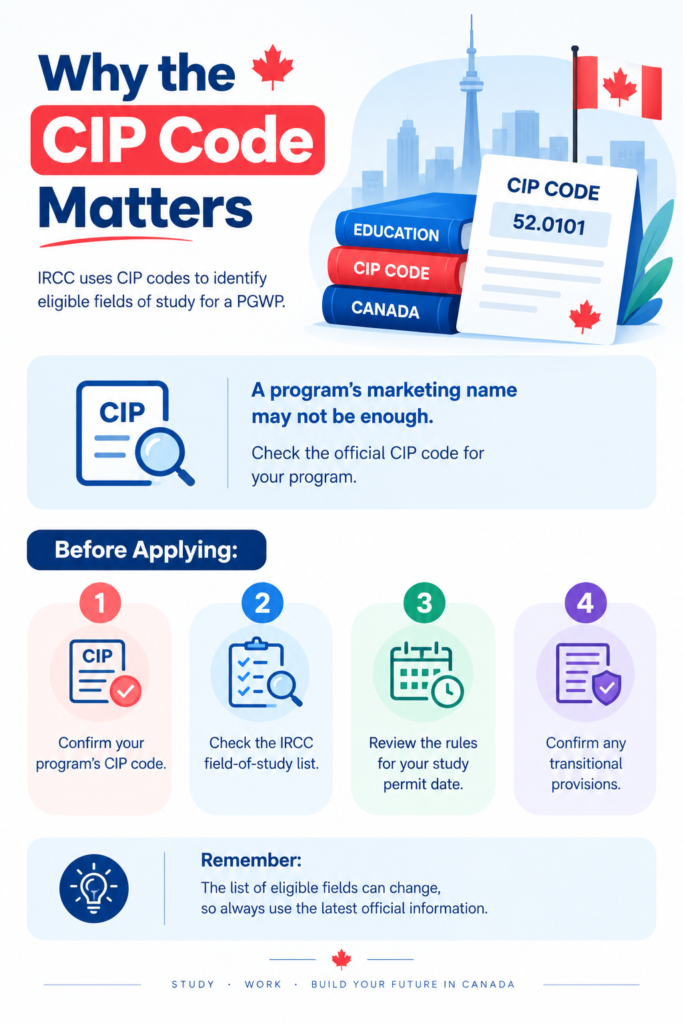
IRCC uses Classification of Instructional Programs (CIP) codes to identify eligible fields of study.
A program’s marketing name may not be sufficient to determine eligibility. Applicants should verify the official CIP code associated with their program.
Before applying:
- Confirm your program’s official CIP code.
- Check the applicable IRCC field-of-study list.
- Review the rules based on your study permit application date.
- Confirm whether any transitional provisions apply.
The list of eligible fields can change, so graduates should use current official information rather than relying on older articles or unofficial lists.
4. Missing the 180-Day Application Deadline
PGWP applicants generally must apply within 180 days of receiving confirmation that they have completed their program.
The relevant date is associated with confirmation of program completion, such as a completion letter or final transcript, rather than necessarily the graduation ceremony date.
For example, a college may issue a completion letter several weeks before the student attends the graduation ceremony.
Waiting until the ceremony to begin preparing an application could result in missing the deadline.
Graduates should:
Submitting an application after the permitted deadline can create serious eligibility problems.
5. Part-Time Studies or Unauthorized Leave
Applicants generally must maintain full-time student status during each academic session of their program, except for the final academic session and certain permitted circumstances.
Studying part-time during an earlier semester or taking an unauthorized leave may affect PGWP eligibility.
Potential issues include:
There may be exceptions depending on the student’s circumstances. Graduates should review the applicable IRCC rules rather than assuming that every break or part-time semester is acceptable.
6. Online Studies and Program Delivery
The way a student completes their program can also affect PGWP eligibility.
Certain rules apply to online studies, particularly studies completed from outside Canada. Time spent studying online from outside Canada after August 31, 2024, generally does not count toward the length of a PGWP.
Graduates should review:
Students who transferred institutions or changed their program delivery should review their complete academic history before applying.
7. Study Permit Status and Missing Documents
Applicants must meet the applicable study permit and supporting-document requirements.
Problems may arise when the information provided does not establish eligibility or when required documents are missing or inconsistent.
Documents to review may include:
A missing document does not automatically mean every application will be refused. However, incomplete evidence can make it difficult for an officer to assess whether the applicant meets the requirements.
Applicants should follow the current document checklist and application instructions carefully.
8. Changing Colleges or Programs
Changing institutions or programs during studies can affect how an applicant’s educational history is assessed.
For example, time spent studying at a non-DLI may not count toward the required program length in certain circumstances. The effect depends on the details of the transfer and applicable rules.
Graduates should review their full study history, particularly if they:
Keeping transcripts and transfer documentation can help establish the details of the student’s educational history.
9. Misunderstanding PGWP Eligibility Before Enrollment
Some students may make education decisions based on assumptions about post-graduation work opportunities.
For example, they may believe that:
These assumptions can lead to confusion and unexpected problems after graduation.
Students should verify the immigration eligibility of their intended program independently and review the rules that apply to their situation.
What Should You Do After a PGWP Refusal?
Receiving a refusal can be stressful, particularly after investing time and money in Canadian education. The appropriate next step depends on the refusal reasons and the applicant’s current immigration status.
Step 1: Read the refusal letter.
Identify the specific reasons provided by the immigration officer. Do not assume that the problem was your language score or educational program without reviewing the decision.
Step 2: Review your application.
Compare the refusal reasons with the documents and information you submitted.
Check whether information was missing, incorrect, inconsistent, or insufficient to establish eligibility.
Step 3: Check your immigration status.
A PGWP refusal does not automatically extend your right to remain or work in Canada.
Your ability to work or stay depends on your current status, any existing authorization, and the circumstances of your application.
If your status is expiring or has already expired, seek advice promptly.
Step 4: Understand your available options
Depending on the circumstances, possible options may include:
Not every refusal can be corrected by simply submitting the same application again. A new application must address the underlying issue, and judicial review is subject to strict deadlines.
How to Reduce the Risk of PGWP Refusal
Although approval cannot be guaranteed, graduates can take practical steps to identify potential eligibility issues before applying.
PGWP application checklist
0 of 7 completed
Reset
Confirm that your institution and program qualify.
Check whether field-of-study requirements apply to you.
Meet the required language level with accepted test results.
Calculate your 180-day application deadline.
Review full-time enrollment and study breaks.
Check online study and program transfer rules.
Prepare complete and consistent supporting documents.
Need Help Understanding Your PGWP Options?
If you have completed your studies in Canada or are preparing to apply for a PGWP, contact Rajveer Chahal Education Consultant for guidance about your situation.
Rajveer Chahal Education Consultant
Get guidance for your Canadian immigration journey. Visit Our Website
Call or WhatsApp: 7068161111 | 7508361111
Conclusion
PGWP refusals in 2026 are a concern for international graduates navigating Canada’s post-study work permit requirements.
Program eligibility, language proficiency, field-of-study restrictions, application deadlines, enrollment history, and study permit conditions can all affect an application.
The key is to understand which requirements apply to your specific circumstances and verify them using current IRCC guidance.
If you have already received a refusal, review the decision carefully before choosing your next step. Acting promptly is particularly important when your immigration status or application deadlines are involved.
Frequently Asked Questions
Q1. Why are PGWP applications refused in 2026?
Ans. Potential reasons include ineligible programs, failure to meet language or field-of-study requirements, missed deadlines, issues with enrollment history, and problems with study permit conditions. The exact reason depends on the applicant’s circumstances.
Q2. Can I get a PGWP if I studied at a DLI?
Ans. Possibly. Studying at a DLI alone does not guarantee eligibility. Your specific program and other applicable requirements must also qualify.
Q3. Is IELTS mandatory for a PGWP?
Ans. Not necessarily IELTS specifically. Most applicants must provide acceptable English or French language test results, subject to applicable exceptions. The required level depends on the credential.
Q4. What is the PGWP 180-day rule?
Ans. Eligible graduates generally must apply within 180 days of receiving confirmation that they completed their program. Applicants should verify the relevant completion date and study permit requirements.
Q5. Can I reapply after a PGWP refusal?
Ans. A refusal does not automatically mean you can never apply again. However, you must still meet the applicable requirements and deadlines. Review the refusal reasons before submitting another application.


