

Completing your studies in Canada is an important milestone, but graduating from a Canadian college or university does not automatically make you eligible for a post-graduation work permit.
The Post-Graduation Work Permit, commonly known as a PGWP, allows eligible international graduates to work in Canada after completing their studies. For many graduates, this Canadian work experience may also become valuable when exploring future immigration pathways.
However, PGWP requirements have changed considerably in recent years. Students applying in 2026 need to pay particular attention to program eligibility, language requirements, field-of-study requirements, their immigration status, passport validity, and the application deadline.
Here is a simplified step-by-step guide to applying for a PGWP from inside Canada in 2026.
What Is a Post-Graduation Work Permit?
A PGWP is an open work permit available to eligible graduates of certain Canadian designated learning institutions.
Unlike an employer-specific work permit, an open work permit generally allows the holder to work for different eligible employers in Canada without being tied to one particular employer.
A PGWP can therefore provide graduates with an opportunity to gain Canadian professional experience after completing their studies.
One important point students should understand is that studying at a designated learning institution does not automatically mean every program offered by that institution is PGWP eligible.
You should always verify the eligibility of your specific institution, program, and personal circumstances before submitting an application.
Who Can Apply for a PGWP in 2026?
Although individual circumstances can differ, applicants generally need to have completed an eligible program at a PGWP-eligible DLI.
The program must generally have been at least eight months in duration, with separate provisions applying to certain programs in Quebec.
Students are also generally expected to have maintained full-time student status during their studies, subject to applicable exceptions.
Another major requirement is the PGWP application deadline.
Eligible graduates generally have up to 180 days after receiving confirmation that they completed their program to submit their PGWP application.
Applicants must also have held a valid study permit at some point during the 180-day period following completion of their studies.
Additional conditions can apply depending on the type of program completed, when the applicant submitted their study permit application, and whether language and field-of-study requirements apply.
Step 1: Confirm Your Program Is PGWP Eligible
Before preparing your application, confirm that your program qualifies.
Do not check only whether your college or university appears on Canada’s DLI list. Your particular program must also meet the applicable PGWP requirements.
Review your:
Students who completed more than one eligible program may, in certain circumstances, be able to combine the length of those programs when IRCC determines the potential duration of their PGWP.
Step 2: Calculate Your 180-Day Deadline
Timing is extremely important.
IRCC generally gives eligible graduates 180 days after confirmation of program completion to submit a PGWP application.
Your institution may provide confirmation through documents such as an official completion letter, transcript, degree, diploma, or certificate.
Do not automatically use your graduation ceremony date to calculate your deadline.
The date your institution officially confirms that you fulfilled the requirements of your program can be more important.
Keep your completion documents carefully and prepare your application well before the deadline rather than waiting until the final weeks.
Step 3: Meet the PGWP Language Requirement
Language testing has become an important part of PGWP eligibility for many graduates.
For PGWP applications submitted on or after November 1, 2024, proof of English or French language ability is generally required, except for certain flight-school graduates.
The required language level depends on the type of credential completed.
Bachelor’s, Master’s, and Doctoral Graduates
Graduates of bachelor’s, master’s, and doctoral degree programs generally require at least:
CLB 7 in English or NCLC 7 in French in each of the four language abilities:
These degree graduates do not have a field-of-study requirement under these PGWP rules.
Other University Programs
Graduates of other university programs generally also require CLB 7 or NCLC 7 in all four abilities.
Depending on when their study permit application was submitted, they may additionally have to meet an eligible field-of-study requirement.
College and Other Non-University Programs
Graduates of eligible colleges, polytechnics, and other non-university programs generally require:
CLB 5 in English or NCLC 5 in French in all four language abilities.
A field-of-study requirement may also apply to certain applicants whose study permit applications were submitted on or after November 1, 2024.
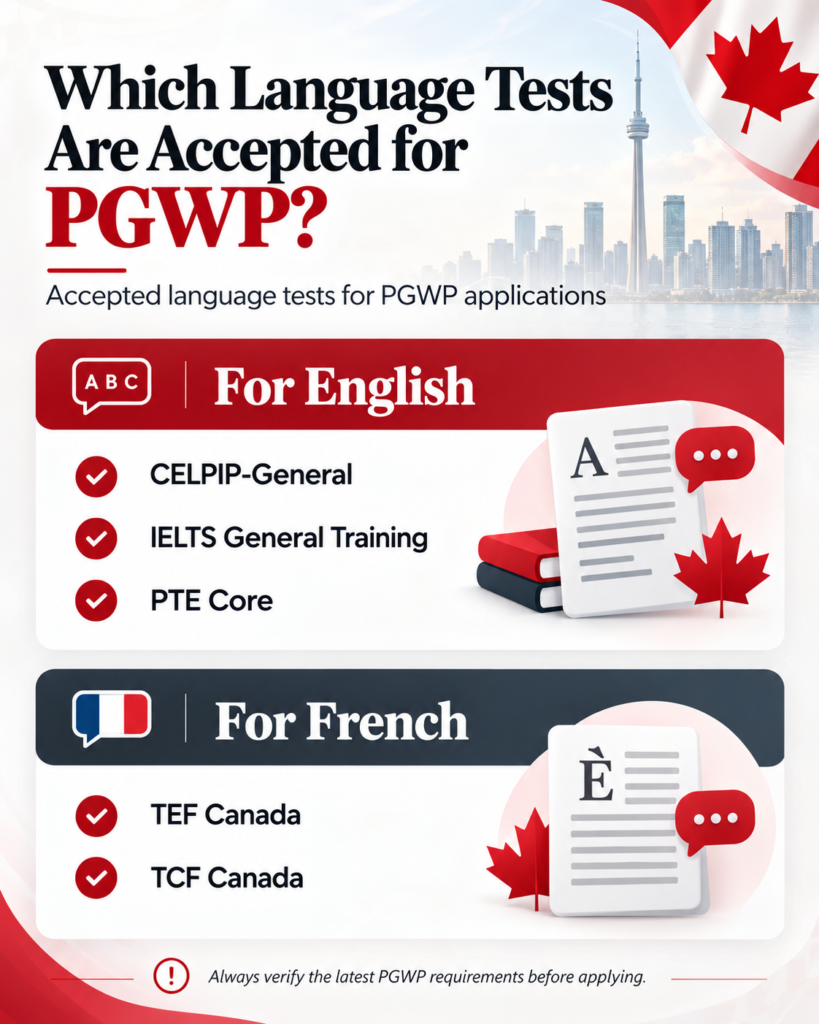
Which Language Tests Are Accepted for PGWP?
For English, the accepted tests listed in the source are
For French:
Language test results must generally be less than two years old when the PGWP application is submitted.
Students should pay close attention to the specific test version required. For example, the source identifies IELTS General Training rather than IELTS Academic for this PGWP requirement.
Step 4: Check the Field-of-Study Requirement
Some applicants must also demonstrate that their program belongs to an eligible field of study.
This requirement is particularly important for certain non-degree graduates whose study permit applications were submitted on or after November 1, 2024.
Eligible programs are linked to occupations experiencing long-term labor shortages and are identified using Classification of Instructional Programs, or CIP, codes.
If this requirement applies to you, make sure your program’s CIP code qualifies before submitting your application.
Applicants who need to submit field-of-study evidence may need to upload it through the Client Information section of their online application.
Step 5: Prepare Your PGWP Documents
Your personalized document checklist will depend on your circumstances, but commonly relevant documents include:
Proof of program completion, such as a degree, diploma, certificate, official school letter, or official transcript.
You should also have your transcript available to demonstrate your academic history and, where necessary, full-time enrollment.
If applicable, include:
Make sure all documents are clear, complete, and consistent.
Names, passport details, program dates, and immigration information should match across your forms and supporting evidence.
Step 6: Check Your Passport Validity
Passport validity can directly affect the length of a PGWP.
If you are otherwise eligible for a three-year PGWP but your passport expires earlier, the work permit may only be issued until the passport expiry date.
For this reason, applicants should check their passport before submitting their application and understand how its expiry date could affect the permit they receive.
Step 7: Apply Through Your IRCC Account
Most PGWP applications are submitted online.
When applying from inside Canada, sign in to your IRCC secure account and complete the required questionnaire.
This generates a personalized document checklist based on your answers.
Carefully enter your:
Review everything before moving to the submission stage.
Step 8: Upload Documents and Pay the Fees
Upload each document to the correct section of the online application.
Even where a document appears optional in the system, make sure you provide it when it is required by the PGWP rules applicable to your situation.
Applicants generally need to pay the work permit processing fee and open work permit holder fee where applicable.
Other costs may arise from language testing, medical examinations, police certificates, or other third-party requirements.
Government fees can change, so verify the applicable amount before submitting.
Step 9: Submit Your Application Carefully
Before clicking submit, compare your application against your supporting documents.
Check your passport, transcript, completion letter, language results, study permit, and application forms for inconsistencies.
Small differences in dates, names, or study information can create unnecessary complications.
After submission, retain your confirmation and payment receipt for your records.
Can You Work While Waiting for Your PGWP?
Submitting a PGWP application does not automatically give every applicant permission to work while waiting for a decision.
According to the source material, your study permit generally needs to have been valid when you submitted the PGWP application if you want to qualify to work while the application is being processed, along with meeting the other applicable requirements.
If your study permit has already expired, different restoration rules may apply.
In some circumstances, a person may have up to 90 days after their study permit expires to apply for restoration and a PGWP. However, they generally cannot work while waiting under this situation until the work permit is approved.
Because immigration status and work authorization can have serious consequences, students should review their status before their study permit expires.
How Long Can a PGWP Be Issued For?
The length of a PGWP depends mainly on the type and duration of the eligible program and passport validity.
For eligible programs lasting at least eight months but less than two years, the PGWP may generally be issued for up to the length of the program.
Eligible programs lasting two years or longer may result in a PGWP of up to three years.
Eligible master’s graduates may qualify for a three-year PGWP even when their master’s program was less than two years, provided the program meets the applicable requirements, including the minimum program duration.
Get Guidance from Rajveer Chahal, Education Consultant
PGWP applications can involve several important requirements, including program eligibility, language scores, field-of-study rules, study history, passport validity, immigration status, and application deadlines.
If you are unsure whether you qualify for a PGWP or want your documents and profile reviewed before submission, you can get professional guidance from Rajveer Chahal Education Consultant.
Frequently Asked Questions About PGWP 2026
Q1. How long do I have to apply for a PGWP after completing my studies?
Ans. Eligible graduates generally have up to 180 days after receiving confirmation that they have completed their program to submit a PGWP application. The completion date shown by your institution is important, so students should not rely only on their graduation ceremony date. Pasted text
Q2. Is a language test required for a PGWP in 2026?
Ans. For many applicants, yes. For applications submitted on or after November 1, 2024, proof of English or French language ability is generally required, except for certain flight-school graduates. The required level depends on the type of program completed. Pasted text
Q3. Which English language tests are accepted for a PGWP?
Ans. The English tests listed in the blog are CELPIP-General, IELTS General Training, and PTE Core. For French, TEF Canada and TCF Canada are listed. Language test results generally need to be less than two years old when the PGWP application is submitted. Pasted text
Q4. Can I work in Canada while waiting for my PGWP decision?
Ans. Not every applicant automatically has authorization to work after submitting a PGWP application. According to the draft, your study permit generally needs to have been valid when you submitted the application, along with meeting the other applicable requirements. Different rules can apply if your study permit has already expired. Pasted text
Q5. Can I get a three-year PGWP after a master’s program shorter than two years?
Ans. Eligible master’s graduates may qualify for a three-year PGWP even if the master’s program was less than two years, provided the program meets the applicable requirements, including the minimum program duration. Passport validity can also affect the final length of the permit issued.
Final Thoughts
Applying for a post-graduation work permit in 2026 is no longer simply a matter of uploading a completion letter and transcript.
Students may need to consider program eligibility, language scores, field-of-study rules, full-time study history, immigration status, passport validity, and application timing.
Preparing early can help you identify potential issues before submitting your application.
If you are unsure about your PGWP eligibility, language requirement, CIP code, documentation, or current immigration status, Rajveer Chahal Education Consultant can help review your profile and explain the requirements applicable to your circumstances.
Immigration rules and procedures can change, so applicants should always verify the latest requirements directly with IRCC before submitting their PGWP application.


