


Canadian work experience can contribute to your CRS profile.
The number of Canada’s Express Entry system remains one of the most important pathways for skilled workers seeking permanent residence. However, many temporary residents and international graduates may misunderstand how Canadian work experience is counted.
The One-Year Work Experience Rule 2026 is particularly important for candidates considering the Canadian Experience Class (CEC). Applicants who do not have enough eligible Canadian work experience may not qualify under CEC, even if they have graduated in Canada, obtained a work permit, or are currently employed.
But there is an important point to understand: the one-year requirement is not a completely new rule introduced in 2026. It remains a core eligibility requirement for the Canadian Experience Class.
What Is the One-Year Work Experience Rule 2026?
Under the Canadian Experience Class, applicants generally need at least 1 year or 1,560 hours of eligible skilled Canadian work experience within the 3 years before applying.
The experience generally needs to be:
The One-Year Work Experience Rule 2026 therefore matters most to temporary workers and international graduates who are planning to use CEC as their Express Entry pathway.
Who Could Be Locked Out of CEC in 2026?
The phrase “locked out” does not mean that these applicants are permanently excluded from Canadian immigration.
It means they may not currently meet the eligibility requirements for the Canadian Experience Class.
Several groups need to be particularly careful.
1. International Students Counting Student Work
One of the most common mistakes is assuming that work performed while studying full-time automatically counts toward the CEC requirement.
Generally, Canadian work experience gained while you were a full-time student does not count toward the minimum CEC requirement.
For example, suppose you completed a two-year program in Canada and worked part-time during your studies. After graduation, you obtained a work permit and started a full-time skilled job.
You should not automatically combine your student employment with your post-graduation employment and assume that you have completed the CEC requirement.
Your qualifying experience needs to meet IRCC’s specific requirements.
2. Workers With Less Than One Year of Qualifying Experience
If you have worked in Canada for only several months, you may not yet meet the CEC eligibility requirement.
Under the One-Year Work Experience Rule 2026, applicants generally need the equivalent of at least 1,560 hours of qualifying Canadian work experience.
This makes the timing of your Express Entry profile important.
If you are close to completing one year of qualifying experience, carefully calculate your eligible hours and employment dates before relying on CEC eligibility.
3. People Working in Non-Qualifying Occupations
Not every Canadian job automatically qualifies for the Canadian Experience Class.
CEC generally requires work experience in:
Your actual job duties are important when determining the appropriate NOC.
You should not select an NOC simply because its job title sounds similar to your position. The duties you actually performed should correspond to the selected NOC.
4. Workers Without Proper Work Authorization
Canadian immigration programs have specific requirements regarding authorized employment.
If your Canadian employment was not properly authorized, you should not assume that the experience will satisfy the CEC requirement.
Keep documentation related to your work authorization, employment dates, hours, salary and job duties.
5. Applicants Who Wait Too Long
CEC experience generally needs to have been obtained during the 3 years before applying.
This is another reason the One-Year Work Experience Rule 2026 should be considered together with the timing of your application.
Canadian work experience does not necessarily remain usable for a CEC application indefinitely.
How Many Hours of Work Experience Are Required?
The CEC benchmark is 1,560 hours, generally equivalent to one year of full-time work at 30 hours per week.
Qualifying experience can also be accumulated through eligible part-time work, subject to IRCC’s rules.
Applicants should maintain accurate records of:
Simply working more hours in a particular week does not necessarily mean you can shorten the required qualifying period. Applicants should follow IRCC’s rules for calculating work experience.
Does One Year of Canadian Work Experience Guarantee PR?
No.
This is one of the biggest misconceptions surrounding Express Entry.
Meeting the CEC work-experience requirement only helps determine whether you are eligible for the program. It does not guarantee an Invitation to Apply (ITA) for permanent residence.
After becoming eligible, candidates may enter the Express Entry pool and receive a Comprehensive Ranking System (CRS) score.
IRCC conducts different types of invitation rounds, and candidates are invited according to the requirements of the particular round.
Therefore:
Eligibility ≠ Invitation ≠ Permanent Residence
You must first qualify for a program, then remain competitive enough to receive an invitation, and finally submit a complete application that meets IRCC’s requirements.
Does Canadian Work Experience Increase Your CRS Score?RS points available depends on factors including the amount of qualifying Canadian work experience and other characteristics of your profile.
Therefore, reaching one year of eligible experience can be important for both CEC eligibility and CRS competitiveness.
However, candidates should calculate their complete CRS profile rather than focusing only on work experience.
Can You Qualify for Express Entry Without One Year of Canadian Experience?
Yes, potentially.
Not qualifying for CEC does not automatically mean that you are excluded from Express Entry.
Express Entry manages three federal immigration programs:
- Canadian Experience Class (CEC)
- Federal Skilled Worker Program (FSWP)
- Federal Skilled Trades Program (FSTP)
Each program has different eligibility requirements.
For example, a candidate may potentially qualify under the Federal Skilled Worker Program based on eligible skilled work experience obtained in Canada or abroad, provided all other requirements are satisfied.
This is why candidates should not assume that CEC is their only Express Entry option.
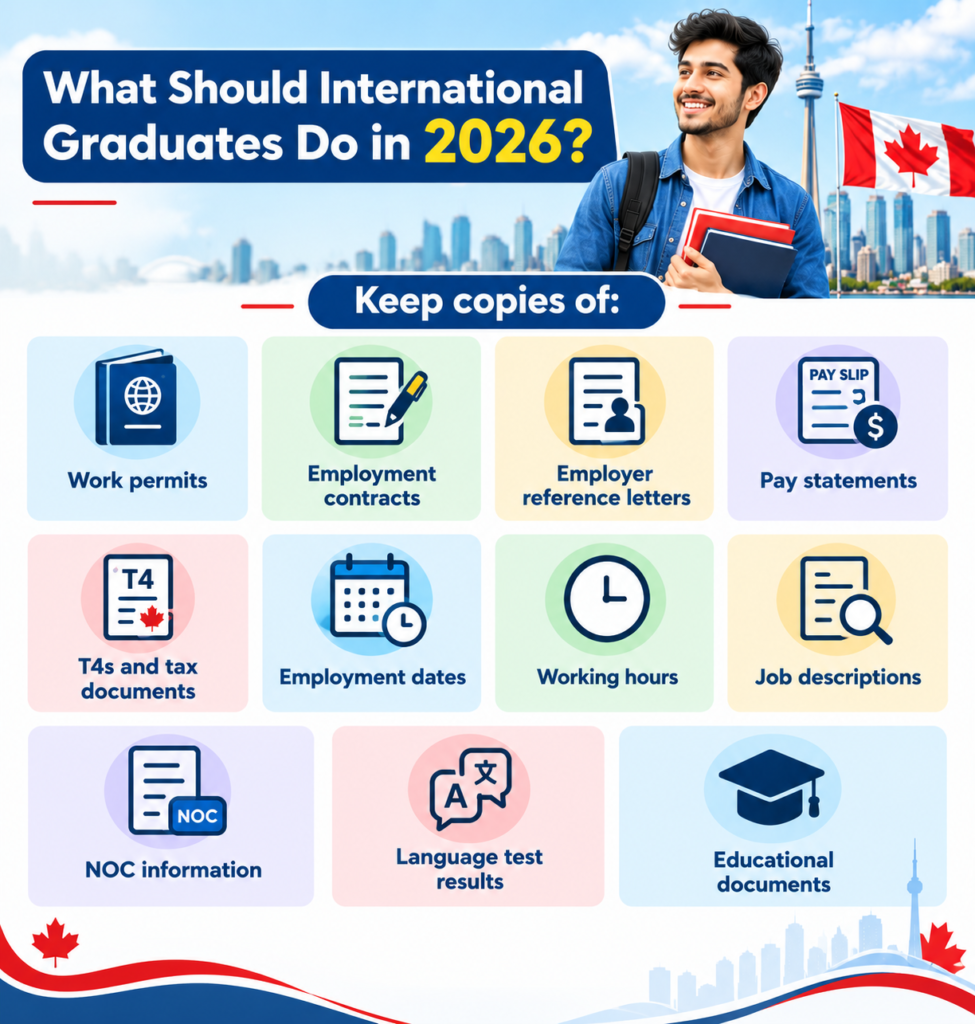
What Should International Graduates Do in 2026?
If you are an international graduate working in Canada, it is important to track your qualifying employment from the beginning.
Keep copies of:
Your employer reference letter should accurately describe the duties you actually performed.
Common Mistakes Under the One-Year Work Experience Rule 2026
❌ Counting student employment automatically
Work completed while studying full-time generally cannot simply be added to your CEC qualifying experience.
❌ Assuming every Canadian job qualifies
Your occupation and actual job duties must meet the applicable requirements.
❌ Applying before meeting the requirement
If you do not meet the CEC eligibility requirements, creating an Express Entry profile does not make you eligible.
❌ Believing one year guarantees an ITA
One year of qualifying experience does not guarantee an invitation to apply.
❌ Choosing a NOC based only on the job title
Your actual duties should support the NOC you claim.
❌ Ignoring the timing of your work experience
CEC experience generally needs to fall within the required three-year period before applying.
Frequently Asked Questions
Q1. Is one year of Canadian work experience mandatory for Express Entry in 2026?
Ans. No. The one-year Canadian work experience requirement generally applies to the Canadian Experience Class (CEC). Other Express Entry programs have different eligibility requirements.
Q2. How much work experience is required for CEC?
Ans. You generally need at least 1 year or 1,560 hours of eligible skilled Canadian work experience within the 3 years before applying.
Q3. Does work experience gained as a student count for CEC?
Ans. Generally, work experience gained while you were a full-time student does not count toward the minimum CEC requirement.
Q4. Can part-time work count toward the one-year requirement?
Ans. Yes. Eligible part-time work can count toward the required experience, provided it meets IRCC’s requirements and you accumulate the required equivalent of 1,560 hours.
Q5. Does one year of Canadian work experience guarantee an ITA?
Ans. No. One year of qualifying experience may help you meet CEC eligibility, but it does not guarantee an Invitation to Apply (ITA). Your CRS score and the requirements of the specific draw also matter.
Q6. Which NOC TEER levels qualify for CEC?
Ans. CEC generally accepts eligible work experience in NOC TEER 0, 1, 2 and 3 occupations. Your actual job duties should support the NOC you claim.
Q7. Can foreign work experience replace Canadian experience for CEC?
Ans. No. Foreign work experience cannot replace the Canadian experience required for CEC. However, foreign experience may be useful when considering other Express Entry programs.
Q8. Can I apply for Express Entry with less than one year of Canadian work experience?
Ans. You may still have Express Entry options through another program if you meet its requirements. However, you generally cannot rely on CEC eligibility until you have the required qualifying Canadian work experience.
Q9. Does completing one year of work automatically increase my CRS score?
Ans. Canadian work experience can contribute to your CRS score, but the points depend on your overall profile and the amount of qualifying experience. One year of work does not guarantee a particular CRS score.
Q10. Is the One-Year Work Experience Rule 2026 a new rule?
Ans. No. The one-year qualifying Canadian work experience requirement for CEC is not a new rule introduced in 2026. It remains an established eligibility requirement for the Canadian Experience Class.
Final Takeaway
The One-Year Work Experience Rule 2026 is an important consideration for international graduates and temporary workers planning to use the Canadian Experience Class.
However, it is important to understand that this is not a new rule that suddenly eliminates everyone from Express Entry. The CEC has long required qualifying Canadian work experience, and applicants must meet the applicable requirements before they can qualify through this program.
If you have less than one year of qualifying experience, are counting student work, or are unsure whether your occupation qualifies, you should review your situation carefully before creating or updating your Express Entry profile.
At the same time, failing to qualify for CEC does not necessarily mean that you have no Express Entry options. Depending on your education, work experience, language ability, and other factors, another federal program or immigration pathway may be available.
Canadian immigration requirements and Express Entry selection priorities can change. Always check the latest information from Immigration, Refugees and Citizenship Canada (IRCC) before making immigration decisions or submitting an application.
Need Help With Your Canada PR or Express Entry Application?
Rajveer Chahal Education Consultant can help you understand your Express Entry options, Canadian Experience Class eligibility, work experience requirements, CRS profile, and Canada PR pathways.
Our team can assist with profile assessment, documentation guidance, Express Entry application support, and immigration pathway planning based on your individual circumstances.
Call: 7508361111 or 7068161111
Contact us today to discuss your Canada immigration and Express Entry options.


