


Ontario is one of Canada’s most popular destinations for immigrants because of its strong economy, employment opportunities, educational institutions, and diverse communities. For skilled workers and other eligible applicants, one important route to permanent residence is the Ontario Immigrant Nominee Program (OINP).
The immigration process can seem complicated because it involves both the provincial government and the federal government. However, understanding the process step by step can make it easier to plan your move to Ontario.
This guide explains the general process of immigrating to Ontario, including the current OINP pathway, the Expression of Interest process, provincial nomination, and the final permanent residence application.
Important: Ontario changed its OINP structure in 2026. Several older OINP streams that appeared in older immigration guides are no longer open. Applicants should always check the latest requirements before applying.
What Is the Ontario Immigrant Nominee Program?
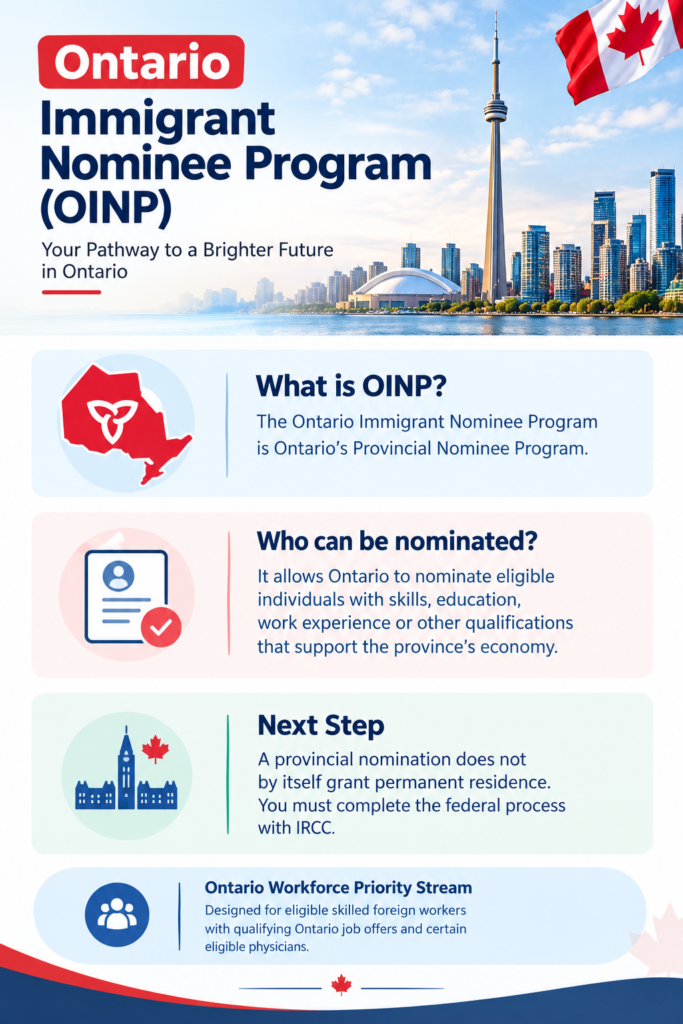
The Ontario Immigrant Nominee Program (OINP) is Ontario’s Provincial Nominee Program. It allows the province to nominate eligible individuals who have skills, education, work experience, or other qualifications that support Ontario’s labour market and economic needs.
A provincial nomination does not by itself grant permanent residence. After receiving an Ontario nomination, applicants must complete the federal permanent residence process with Immigration, Refugees and Citizenship Canada (IRCC).
Ontario’s current OINP system includes the Ontario Workforce Priority Stream, which is designed for eligible skilled foreign workers with qualifying Ontario job offers and certain eligible physicians.
Step-by-Step Process to Canadian Province of Ontario
Step 1: Decide Why You Want to Move to Ontario
Before beginning your immigration application, understand why Ontario is the right province for you.
Ontario offers opportunities in areas such as:
You should also consider the cost of living, employment opportunities, housing, education and your long-term settlement plans.
For provincial immigration, you should genuinely intend to live and work in the province that nominates you. Canada’s PNP requirements include an intention to reside in the nominating province.
Step 2: Check the Current Ontario Immigration Pathway
One of the most important steps is identifying which Ontario immigration pathway is currently available to you.
Ontario’s immigration programs can change as the province adjusts its priorities and nomination allocations. Therefore, applicants should not rely on older articles that list streams that have since closed.
The current Ontario Workforce Priority Stream can consider eligible skilled foreign workers with qualifying job offers in Ontario, as well as certain self-employed physicians.
Your eligibility depends on factors such as
The requirements can vary according to the occupation and applicant category.
Step 3: Find an Eligible Job in Ontario
For applicants using the Ontario Workforce Priority Stream, an eligible Ontario job offer is an important part of the process.
The job generally needs to meet requirements relating to:
The employer also has responsibilities in the OINP application process.
This means that getting a job offer is not simply about receiving an employment letter. The position and employer must also satisfy the relevant Ontario requirements.
Step 4: Check Your NOC and Occupation
Canada uses the National Occupational Classification (NOC) system to classify occupations.
Your job duties should accurately match the NOC associated with your occupation. Choosing a NOC only because its title appears similar to your job can create problems if your actual duties do not match.
Before applying, carefully review:
Your NOC can affect your eligibility and the documents you need to provide.
Step 5: Check Your Work Experience
Work experience is another important part of the Ontario immigration process.
Depending on your circumstances and the category under which you qualify, Ontario may consider different work-experience requirements.
For example, requirements can differ based on:
Do not assume that having any amount of work experience automatically makes you eligible. Your experience must meet the specific requirements of the applicable pathway.
Step 6: Meet the Language Requirements
Language ability can be an important eligibility factor.
Depending on the pathway and occupation, applicants may need to demonstrate proficiency in English or French through an approved language test.
Accepted language tests can include:
Your test results must meet the minimum language level required for your particular application.
Because language-test validity periods and program requirements can change, check the current requirements before submitting your application.
Step 7: Check Your Education Requirements
Your educational background may also affect your eligibility.
Depending on the applicable category, you may need a post-secondary credential or another qualifying educational background.
If your education was completed outside Canada, you may need an Educational Credential Assessment (ECA) or other evidence depending on the specific immigration process.
Keep copies of:
Step 8: Prepare Your Documents
Preparing documents early can help prevent delays.
Depending on your application, documents may include:
For the federal permanent residence stage, IRCC also requires applicants to provide the documents specified in the applicable document checklist.
Step 9: Your Ontario Employer Starts the Process
Under the current Ontario Workforce Priority Stream, the employer has an important role.
The employer initiates the process through the OINP Employer Portal and submits the required information about the position and business.
The employer may need to demonstrate that the business meets Ontario’s eligibility requirements and that the offered position satisfies the program rules.
This is an important difference from simply submitting an immigration application independently.
Step 10: Register an Expression of Interest
After the employer has initiated the required process, an eligible applicant can register an Expression of Interest (EOI) with Ontario.
The EOI provides information about your profile and allows Ontario to assess candidates according to its selection system.
Depending on the stream and current rules, factors can include:
Registering an EOI does not guarantee an invitation to apply.
Step 11: Receive an Invitation to Apply
Ontario may invite selected candidates to submit an application.
If you receive an invitation, carefully review the deadline and requirements.
You should ensure that:
Missing a deadline or providing incorrect information can affect your application.
Step 12: Submit Your OINP Application
After receiving an invitation, you and your employer may have specific deadlines for submitting the required information.
The applicant must provide the required documents and pay the applicable provincial application fee.
Ontario will then assess the application against the requirements of the applicable pathway.
The province may request additional documents or information if necessary.
Step 13: Receive an Ontario Nomination
If Ontario approves your application, you receive a provincial nomination.
However, an Ontario nomination is not the same as permanent residence.
The federal government is responsible for making the final decision on your permanent residence application.
At this stage, the next steps depend on whether your nomination is connected to the Express Entry system or follows the non-Express Entry process.
Express Entry vs. Non-Express Entry
Ontario applicants may eventually use one of two federal processes, depending on their eligibility and nomination pathway.
Express Entry
If you qualify for an Express Entry-linked provincial nomination, the nomination can provide 600 additional Comprehensive Ranking System (CRS) points.
After accepting the nomination, you may receive an Invitation to Apply for permanent residence through Express Entry.
If you receive an Invitation to Apply, you generally have 60 calendar days to submit your permanent residence application.
Non-Express Entry
If your provincial nomination is not processed through Express Entry, you can follow the federal non-Express Entry PNP process.
After receiving the nomination, you apply for permanent residence through the IRCC process and submit the required forms, documents and fees.
Step 14: Submit Your Permanent Residence Application
Once you have the required provincial nomination, the federal stage begins.
You may need to provide:
Make sure your application is complete before submission. An incomplete application can be returned or rejected.
Step 15: Complete Federal Background and Admissibility Checks
IRCC assesses your application after submission.
The federal government may review:
You may be asked to provide additional information during processing.
Processing times can vary depending on the application type, completeness, verification requirements and the number of applications being processed.
Step 16: Receive Your Permanent Residence Decision
If IRCC approves your application, you can complete the final steps to become a permanent resident of Canada.
After your permanent resident status is confirmed, IRCC provides the required confirmation documents and begins the process for your first PR card.
You can then settle in Ontario and begin building your life and career in the province.
Ontario Immigration Process at a Glance
The process can be summarized as:
Check eligibility → Find an eligible Ontario pathway → Obtain a qualifying job offer if required → Employer begins process → Register EOI → Receive invitation → Submit OINP application → Receive nomination → Apply to IRCC → Complete federal checks → Receive PR decision → Settle in Ontario
Documents You May Need for Ontario Immigration
While the exact document list depends on your pathway, applicants may need:
| Document | Why It May Be Required |
| Passport | Identity and travel document |
| Language test | Demonstrates language ability |
| Degree/Diploma | Proof of education |
| ECA | May verify foreign education |
| Employment letters | Proof of work experience |
| Job offer | Required for applicable pathways |
| Employment contract | Details of the offered position |
| Police certificate | Security/admissibility assessment |
| Medical examination | Medical admissibility |
| Civil documents | Family and personal information |
| Proof of legal status | Required in applicable cases |
Always follow the document checklist applicable to your specific application.
Common Mistakes to Avoid
1. Using an Outdated OINP Stream
Ontario’s immigration programs change over time. Older articles may mention OINP streams that are no longer available.
Always verify the current program directly through Ontario’s official website.
2. Choosing the Wrong NOC
Your NOC should accurately reflect your actual job duties. A mismatch can create serious issues during assessment.
3. Ignoring Employer Requirements
For employer-driven pathways, the employer and the position must meet specific requirements. Your eligibility alone may not be enough.
4. Submitting Incomplete Documents
Missing documents, signatures, or information can delay or negatively affect an application.
5. Letting Your Language Test Expire
Check the validity of your language test before submitting your federal application.
6. Assuming Nomination Means Permanent Residence
A provincial nomination is an important step, but IRCC makes the final permanent residence decision.
7. Relying on Old Immigration Information
Ontario immigration rules can change quickly. Always check the latest requirements before making an application or immigration decision.
Frequently Asked Questions About Moving to Ontario
Q1. Is Ontario a good province for immigrants?
Ans. Ontario is one of Canada’s major economic centres and offers employment opportunities across many industries. However, the best province for an individual depends on their occupation, qualifications, job prospects, family situation and immigration eligibility.
Q2. Can I immigrate to Ontario without a job offer?
Ans. It depends on the immigration pathway. The current Ontario Workforce Priority Stream is primarily designed around qualifying employment in Ontario, while certain eligible physicians may qualify under specific provisions without a job offer.
Other federal immigration pathways may also be available depending on your profile.
Q3. How long does Ontario immigration take?
Ans.There is no single processing time for everyone. The total timeline can include the provincial stage, invitation or nomination stage, and federal permanent residence processing. Federal processing times can vary based on application type, completeness, and other factors.
Q4. Does Ontario immigration lead directly to permanent residence?
Ans. No. A provincial nomination supports your permanent residence application, but IRCC makes the final decision on permanent residence.
Q5. Can I apply through Express Entry?
Ans. Potentially, yes. If you meet the requirements of an eligible Express Entry program and an Express Entry-linked provincial nomination, Ontario’s nomination can provide 600 additional CRS points.
Q6. What happens after receiving an Ontario nomination?
Ans. The next step is the federal permanent residence process. Depending on the pathway, you may apply through Express Entry or the non-Express Entry PNP process.
Q7. Can international graduates immigrate to Ontario?
Ans. Graduating in Ontario does not automatically provide permanent residence. However, certain applicants, including eligible recent Ontario graduates, may qualify under current OINP requirements if they meet the applicable criteria.
Q8. Is French useful for immigrating to Ontario?
Ans. French can be an advantage for some Canadian immigration pathways and employment opportunities. However, you should check the exact language requirements of the immigration pathway you are applying through.
Final Thoughts
Moving to Ontario through Canada’s immigration system requires careful planning. The process generally involves identifying the right immigration pathway, checking your eligibility, preparing your documents, meeting Ontario’s requirements, obtaining a provincial nomination where applicable, and completing the federal permanent residence process.
Because Ontario’s immigration programs can change, applicants should be particularly careful when using older online guides. In 2026, Ontario has updated its OINP structure, so information about previously available streams may no longer apply.
Before submitting an application, check the latest requirements from the Government of Ontario and IRCC or consult a qualified Canadian immigration professional.
Ready to explore your options for immigrating to Ontario? Start by reviewing your occupation, education, work experience, language ability, and job prospects to determine which pathway may fit your profile.
Planning Your Move to Ontario?
If you are planning to migrate to the Canadian Province of Ontario or exploring your Canadian immigration options, Rajveer Chahal Education Consultant can help you understand suitable pathways, assess your options, and prepare your application with confidence.
📞 7508361111 | 7068161111


