


Canada continues to be one of the top study destinations for international students because of its world-class education system, global career opportunities, and high quality of life. However, before applying, students must clearly understand How Much Money Is Required for Canada Study Visa in 2026.
The Canadian government has updated its financial proof requirements, making it essential for applicants to plan their finances carefully. From tuition fees and living expenses to GIC and bank balance requirements, every student must meet the official eligibility criteria to obtain a study permit.
In this blog by Rajveer Chahal Education Consultant, we will explain the complete Canada study visa financial requirements, including the latest proof of funds rules, estimated expenses, and important FAQs for Indian students.
Why Financial Proof Is Important for a Canada Study Visa
When applying for a Canadian study permit, Immigration, Refugees and Citizenship Canada (IRCC) wants to ensure that students can financially support themselves during their stay in Canada. Students must demonstrate that they have enough funds to pay for:
Meeting the Canada study permit proof of funds requirement significantly improves the chances of visa approval.
How Much Money Is Required for Canada Study Visa in 2026?
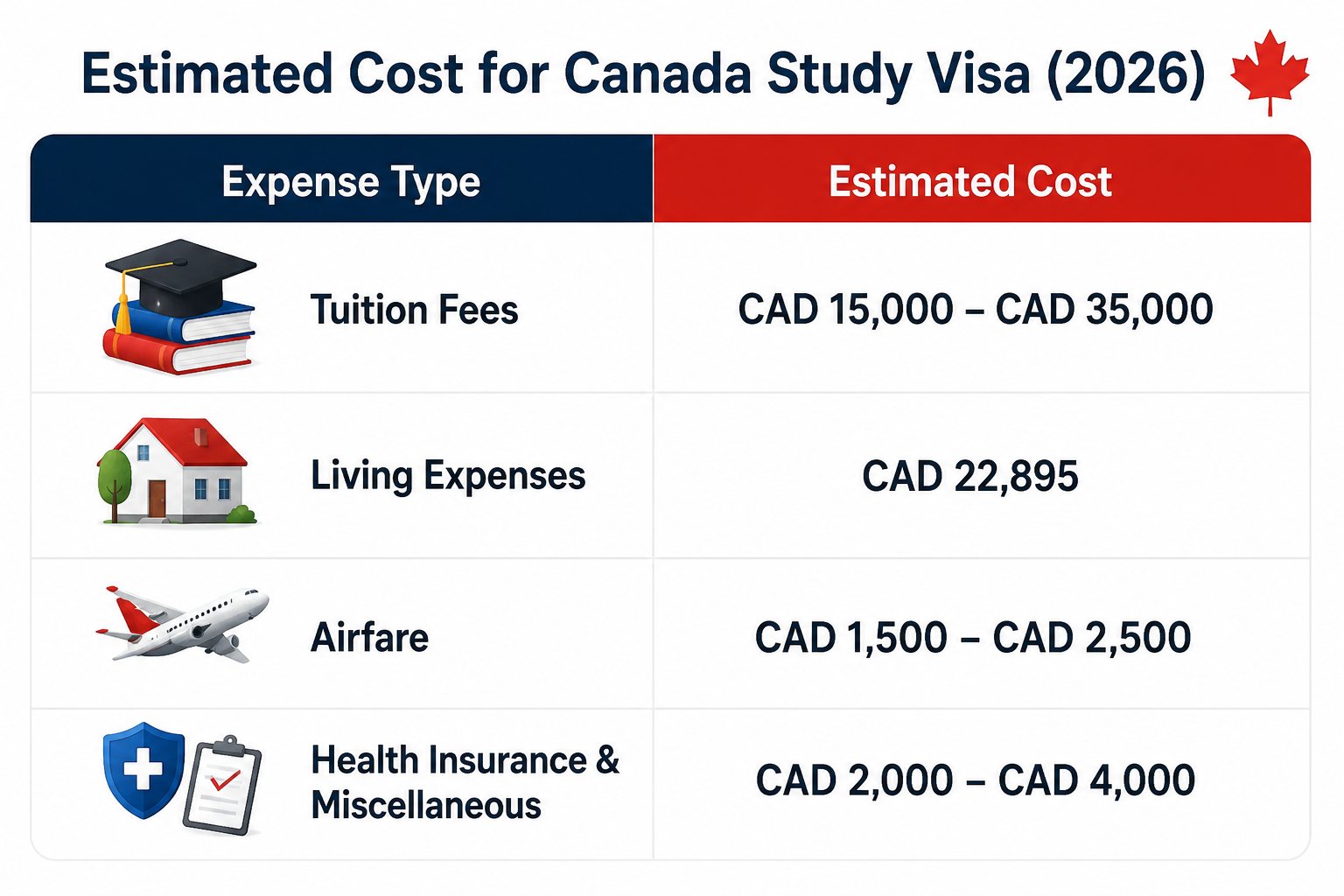
The latest IRCC update states that international students outside Quebec must show at least CAD 22,895 for living expenses. This amount excludes tuition fees and travel costs.
Therefore, the total estimated cost for a student generally includes:
So, if you are wondering How Much Money Is Required for Canada Study Visa, most students should prepare funds between CAD 40,000 and CAD 60,000 depending on their course and location.
Minimum bank balance for Canada student visa
One of the most searched questions among students is about the Minimum bank balance for Canada student visa applications.
The bank balance requirement depends on:
For a single student, the recommended minimum balance should cover:
Students from India are advised to maintain a strong and stable financial profile for at least 4–6 months before applying.
Understanding the GIC Requirement
The GIC amount for Canada student visa applications remains an important part of the Student Direct Stream (SDS)-style financial preparation, even though SDS officially ended.
A Guaranteed Investment Certificate (GIC) helps prove that students have funds available for living expenses in Canada.
Currently, many institutions recommend maintaining a GIC close to the updated living expense requirement. Students should always check the latest bank and IRCC guidelines before purchasing a GIC.
Popular Canadian banks offering GIC accounts include:
Canada study permit proof of funds Documents
Students must submit valid financial documents to satisfy the Canada study permit proof of funds requirement.
Accepted documents generally include:
Ensure that all documents are genuine, recent, and properly verifiable.
Minimum funds required for Canada study permit from India
Indian students applying for Canadian universities often ask about the Minimum funds required for Canada study permit from India.
Although the official minimum may vary, most visa experts recommend showing:
For diploma programs, the overall financial requirement may be lower compared to master’s or MBA programs.
Students applying from India should also maintain proper financial consistency to avoid visa refusal under insufficient funds concerns.
Tuition Fees in Canada
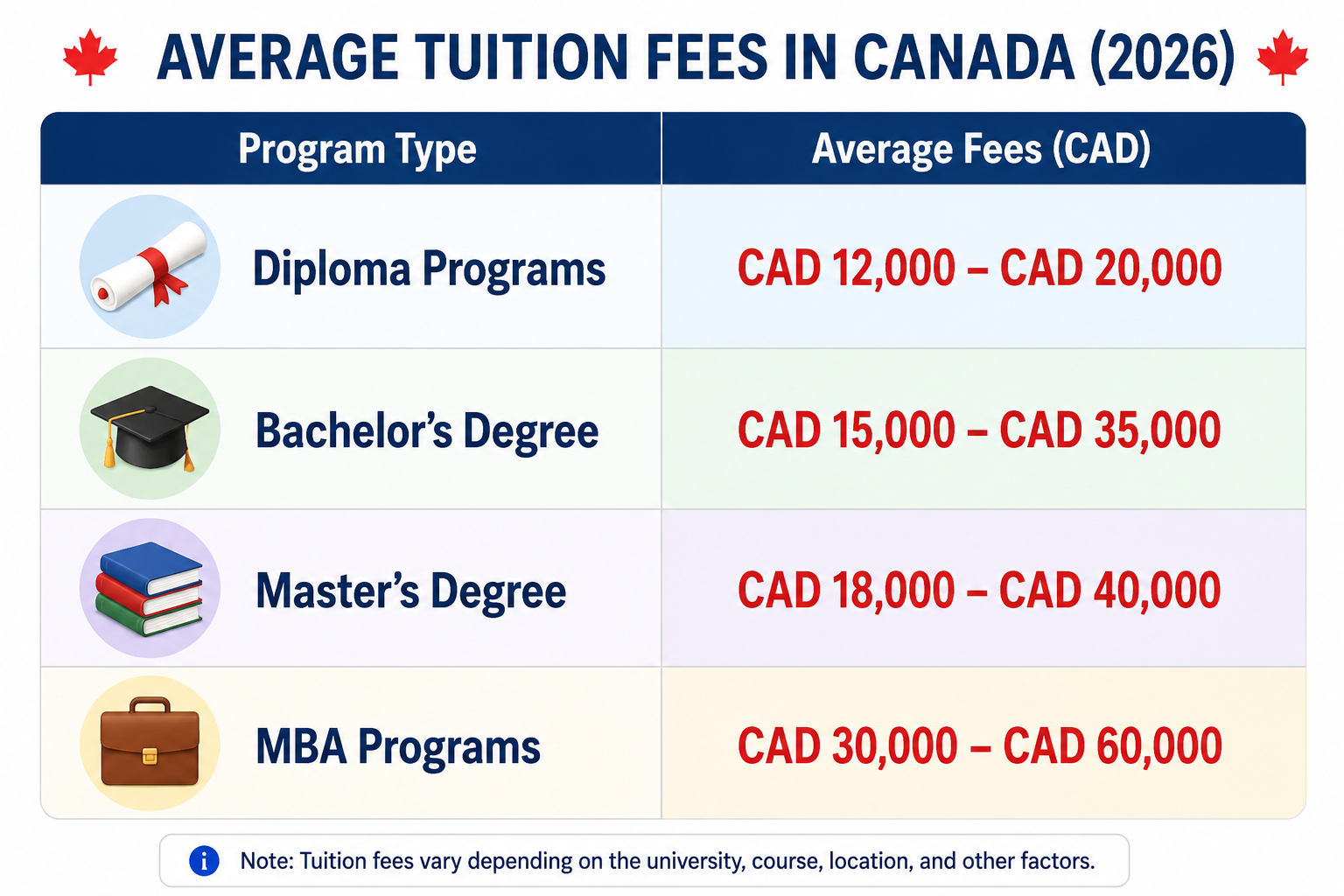
Tuition fees vary depending on the institution and program.
Average Annual Tuition Fees
Cities like Toronto and Vancouver generally have higher tuition and living costs compared to smaller cities.
Living Expenses in Canada
Living expenses depend on lifestyle and location.
Estimated Monthly Expenses
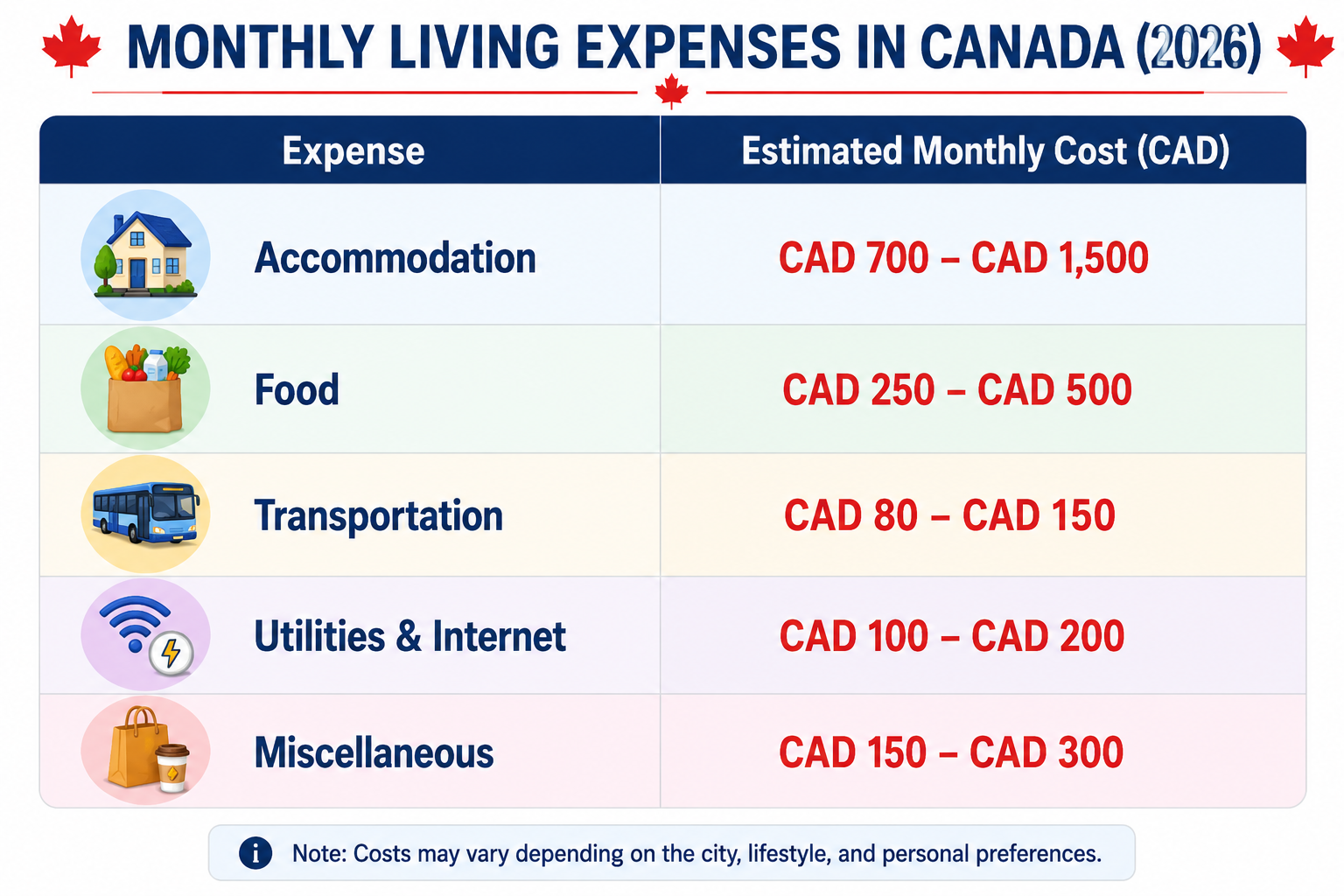
Students can reduce costs by:
How much bank balance is required for Canada study visa in 2026
Students frequently search for How much bank balance is required for Canada study visa in 2026 because financial rules have changed recently.
A safe financial profile should ideally include:
Showing higher funds often strengthens the visa application and demonstrates financial capability.
According to official updates from Immigration, Refugees and Citizenship Canada (IRCC), Canada plans to issue only 305,900 new study permits annually for 2026, continuing stricter intake controls introduced in 2024 and 2025.
Canada student visa proof of funds requirements latest update
According to the Canada student visa proof of funds requirements latest update, IRCC increased the living expense threshold to reflect rising living costs in Canada.
This means students now need stronger financial documentation compared to previous years.
Applicants should carefully prepare:
Incomplete or weak financial documents may lead to visa delays or refusals.
Total cost and GIC amount for Canada study visa applicants
The Total cost and GIC amount for Canada study visa applicants depends on course level, city, and university.
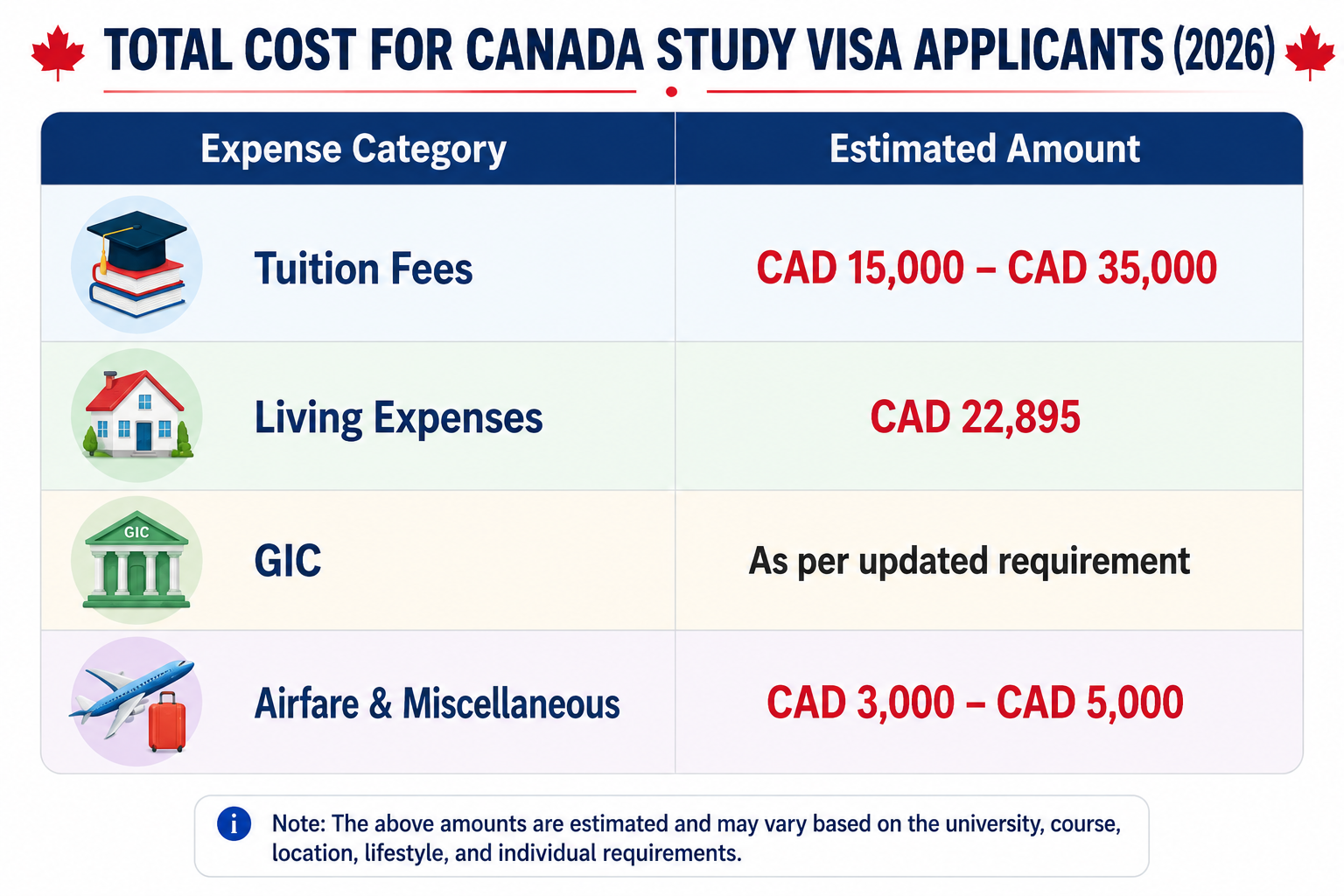
Here’s an estimated breakdown for Indian students:
Planning finances early helps students avoid last-minute stress during the visa process.
Final Thoughts
Understanding How Much Money Is Required for Canada Study Visa is one of the most important steps before applying to study in Canada.
Students must carefully calculate tuition fees, living expenses, and proof of funds requirements before submitting their application. A strong financial profile not only improves visa approval chances but also ensures a smooth student life in Canada.
If you are planning to study in Canada in 2026, make sure your documents are accurate, updated, and financially convincing.
Talk to our experts at 7508361111 or 7068161111 for professional Canada immigration guidance and support. Contact us for more details and further assistance
Related Articles:
FAQs
1. What is the minimum bank balance required for a Canada study visa?
Students should ideally show first-year tuition fees plus CAD 22,895 for living expenses.
2. Is GIC mandatory for a Canada student visa?
A GIC is strongly recommended as financial proof for living expenses.
3. How much money is required for Canada study visa from India?
Most Indian students should prepare approximately CAD 40,000–60,000 including tuition and living costs.
4. Can education loans be shown as proof of funds?
Yes, approved education loan sanction letters are accepted.
5. How many months of bank statements are required?
Generally, 4–6 months of bank statements are preferred.
6. What happens if financial proof is weak?
Weak financial documents may lead to visa refusal.
7. Are tuition fees mandatory before visa application?
Many students pay at least the first semester or first-year tuition fees before applying.
8. Can parents sponsor a Canada study visa?
Yes, parents can sponsor students by showing income and savings proof.
9. Does the required amount change every year?
Yes, IRCC may revise living expense requirements annually.
10. Which financial documents are most important?
Bank statements, tuition fee receipts, GIC certificates, income proof, and education loan documents are highly important.