


Canada’s immigration system is changing rapidly, and one of the biggest debates among applicants today is around Inside Canada vs Outside Canada Applicants 2026 and whether people already living in Canada have a stronger advantage over those applying from abroad. With category-based draws, targeted occupations, and increasing preference for Canadian work experience, many aspiring immigrants are now questioning whether moving to Canada first as a student or worker is becoming the smarter pathway toward Permanent Residency.
Let’s have a look at some of the real-world scenarios. Rahul is a software engineer living in India with five years of experience and a decent CRS score. He has never visited Canada but dreams of settling there permanently. On the other hand, Simran is already in Canada on a Post-Graduation Work Permit after completing her studies in Ontario. She has one year of Canadian work experience and is employed by a local company.
Both want Canada PR in 2026. However, their immigration journeys are completely different. In this blog by Rajveer Chahal Education Consultant, we will understand the complete comparison between Inside Canada vs Outside Canada Applicants.
Why This Debate Matters in 2026
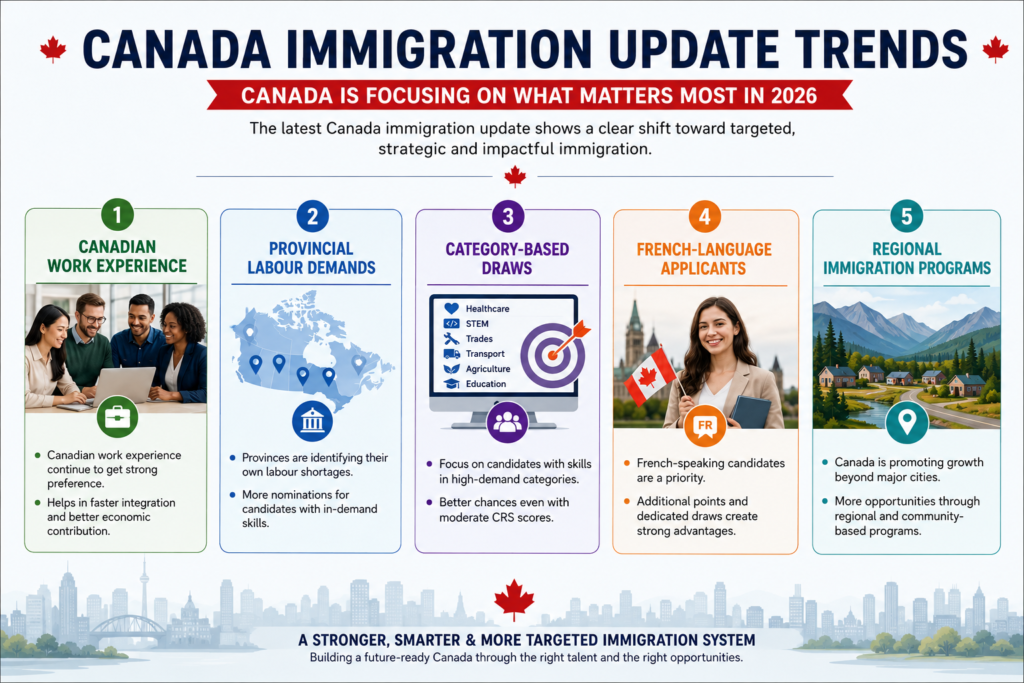
The Canadian government continues to welcome skilled immigrants, but the selection process has evolved significantly. Earlier, general Express Entry draws dominated the system. Today, Canada immigration update trends show increasing focus on:
- Canadian work experience
- Provincial labour demands
- Category-based draws
- French-language applicants
- Regional immigration programs
Because of these changes, many people believe applicants already inside Canada now have an advantage.
While this is partly true, the reality is more balanced and depends heavily on occupation, profile strength, and immigration strategy.
IRCC stated that the economic immigration category will represent nearly 62% of total PR admissions by 2027, showing Canada’s increasing focus on skilled workers and labour-market-based immigration.
Advantages for Applicants Inside Canada
Check out the advantages for all applicants inside Canada.
- Canadian Work Experience Adds Strong Value
One of the biggest benefits for inside-Canada applicants is Canadian work experience. Under Canada Express Entry 2026, local work experience significantly improves CRS scores.
Employers and immigration authorities often prefer candidates who already understand:
- Canadian workplace culture
- Communication standards
- Local job expectations
- Economic environment
For example, an IT professional working in Toronto for one year may receive additional CRS points compared to an overseas applicant with similar foreign experience.
This makes Canadian experience one of the strongest factors in modern Canada PR 2026 selection.
- International Students Have Better Transition Opportunities
Canada PR for international students continues to remain an important pathway. Students studying in Canada can:
- Gain Canadian education credentials
- Apply for Post-Graduation Work Permits
- Build local work experience
- Improve language proficiency
- Connect with employers directly
For instance, a student completing a healthcare program in British Columbia may quickly qualify for provincial immigration streams targeting healthcare workers.
This pathway gives inside-Canada applicants more flexibility compared to overseas candidates applying directly.
- Provincial Nominee Programs Favour Local Candidates
Many Provincial Nominee Programs (PNPs) are increasingly prioritising candidates already working in the province.
Provinces often prefer applicants who:
- Have valid work permits
- Are employed locally
- Have job offers
- Contribute to regional economies
For example, truck drivers, hospitality workers, and healthcare professionals already working in provinces like Alberta, Saskatchewan, or Manitoba often receive targeted invitations faster.
This is one reason why many temporary workers now see stronger PR opportunities in Canada.
Challenges for Applicants Inside Canada
Although inside Canada, applicants have certain advantages, their journey is not always easy.
- Rising Competition Among Temporary Residents
Canada currently has a very large temporary resident population, including international students and foreign workers. This means competition for PR pathways has increased significantly.
Not every student or worker automatically qualifies for PR. Candidates still need:
- Competitive CRS scores
- Skilled work experience
- Valid documentation
- Occupation demand
Many temporary residents also struggle because their occupations may not align with category-based draws.
- Cost of Living Pressure
Living in Canada has become expensive, especially in cities like Toronto and Vancouver. Some applicants face financial stress while trying to maintain status, gain experience, and qualify for PR.
This creates pressure on temporary residents who expected faster PR pathways.
Advantages for Outside Canada Applicants
Given below are the advantages for outside Canada applicants.
- Skilled Professionals Still Have Strong Opportunities
Despite increasing focus on local applicants, overseas professionals still remain extremely important for Canada’s immigration goals.
Canada continues facing shortages in:
- Healthcare
- Skilled trades
- STEM occupations
- Construction
- Transportation
- Agriculture
A skilled nurse from India or a welder from the UAE may still receive invitations directly through category-based Express Entry draws.
Canada immigration update trends clearly show that in-demand occupations remain highly valuable regardless of location.
- Lower Financial Burden Before Immigration
Outside Canada, applicants do not face the immediate high living expenses associated with studying or working temporarily in Canada.
Many applicants prefer building strong profiles from abroad by:
- Improving IELTS scores
- Learning French
- Gaining work experience
- Applying through PNPs
This can sometimes be financially safer compared to spending large amounts on international education.
- French Language Applicants Have Major Advantages
French-speaking applicants living outside Canada are becoming increasingly valuable under Canada Express Entry 2026.
Candidates with strong French proficiency often receive targeted invitations even with lower CRS scores.
This has opened strong opportunities for overseas applicants from multiple countries.
Where Outside Canada Applicants Face Difficulty
Read the pointers below to know what difficulties outside Canada applicants face.
- CRS Score Competition
General Express Entry draws often remain highly competitive. Applicants outside Canada without category advantages may struggle with rising CRS cut-offs.
- Limited Employer Connections
Candidates outside Canada may find it harder to secure Canadian job offers or understand provincial labour requirements.
This can sometimes slow down their immigration process.
So, Who Has Better Chances in 2026?
The answer depends on the applicant’s profile.
Inside Canada applicants may have advantages through:
- Canadian experience
- Provincial employment
- Education pathways
- Employer connections
Outside Canada applicants may succeed strongly if they have:
- In-demand occupations
- High language scores
- French proficiency
- Strong work experience
- Provincial nominations
In reality, Canada PR 2026 is becoming less about location and more about economic value.
The Future of Canada Immigration
Canada’s immigration system is shifting toward targeted and selective immigration. Instead of inviting massive numbers randomly, the government now focuses on applicants who can fill labour shortages and integrate quickly.
Future Canada immigration update trends may continue emphasising:
- Regional immigration
- Healthcare occupations
- Trades and construction
- French-speaking candidates
- Canadian work experience
Applicants must now prepare strategically rather than relying on old immigration trends.
Final Thoughts
The debate around Inside Canada vs Outside Canada Applicants in 2026 does not have a simple answer. While candidates already in Canada may benefit from local education and work experience, skilled overseas professionals still have excellent pathways through category-based draws and provincial programs. The key to success in Canada Express Entry in 2026 is understanding Canada’s labour market needs and aligning your profile accordingly.
Whether you are inside Canada or applying from abroad, the strongest applicants will always be those who plan carefully, stay updated with immigration trends, improve their language scores, and focus on in-demand occupations. Contact us for more details and further assistance.
FAQs
1. Do applicants inside Canada have better PR chances in 2026?
Applicants already in Canada may have certain advantages because of Canadian work experience, local education, and employer connections. However, skilled overseas applicants with strong profiles and in-demand occupations still have excellent PR opportunities.
2. Is Canada prioritising temporary residents for PR?
Yes. Recent Canada immigration updates show increased focus on transitioning temporary residents, international students, and foreign workers already living in Canada toward permanent residency pathways.
3. Can outside Canada applicants still get PR through Express Entry?
Absolutely. Outside Canada applicants can still receive Invitations to Apply (ITAs), especially if they have high CRS scores, French-language proficiency, or experience in targeted occupations like healthcare, STEM, trades, or transport.
4. What occupations are currently in demand for Canada PR 2026?
Canada is prioritising occupations in:
- Healthcare
- STEM fields
- Skilled trades
- Transportation
- Agriculture
- Education
- French-language categories
These sectors are receiving category-based Express Entry invitations.
5. Is Canadian work experience important for PR?
Yes. Canadian work experience adds valuable CRS points and improves an applicant’s chances under Canada Express Entry 2026 and Provincial Nominee Programs (PNPs).
6. Does studying in Canada improve PR chances?
Yes. International students can gain Canadian education credentials, work experience through Post-Graduation Work Permits (PGWPs), and better access to provincial immigration pathways.
7. Are CRS scores still important in 2026?
Yes. Although category-based draws are becoming more common, CRS scores still play a major role in Express Entry selection. Higher IELTS scores, French proficiency, and work experience can improve CRS significantly.
8. Is learning French beneficial for Canada immigration?
Definitely. French-speaking applicants can receive additional CRS points and may qualify under dedicated French-language category draws, which often have lower CRS cut-offs.
9. Which is better for PR: studying in Canada or applying directly from abroad?
It depends on the applicant’s financial situation, occupation, and long-term strategy. Studying in Canada can provide local experience, while skilled overseas applicants may still succeed directly through Express Entry or PNP programs.
10. What is the future of Canada immigration after 2026?
Canada is expected to continue focusing on selective immigration based on labour shortages, economic contribution, regional immigration, and category-based selection rather than only high CRS scores.