


Many people visit Canada hoping to explore employment opportunities and build a future in the country. Some believe that obtaining a job offer while visiting Canada is enough to change their visitor status into a work permit. However, Canadian immigration rules do not work that way.
The temporary policy that allowed eligible visitors to apply for an employer-specific work permit from inside Canada ended on August 28, 2024. In 2026, visitors can no longer rely on that policy to transition from visitor status to a work permit.
However, this does not mean that every person who is physically present in Canada must apply from outside the country. Certain foreign nationals may still qualify to apply from inside Canada under separate immigration rules.
Understanding the difference is essential before accepting a job offer, submitting an application, or making plans to remain in Canada.
What Was the Visitor-to-Work-Permit Policy?
The Canadian government introduced a temporary public policy in August 2020 during the COVID-19 pandemic. At that time, travel restrictions made it difficult for some foreign nationals to leave Canada, while employers were also experiencing labor shortages.
The policy allowed eligible visitors in Canada to apply for an employer-specific work permit without leaving the country, provided they met the conditions.
Certain former work permit holders who had changed their status to visitor could also request authorization to work for their prospective employer while their new work permit application was being processed.
The policy was extended beyond its original period but was ultimately terminated by Immigration, Refugees and Citizenship Canada (IRCC) on August 28, 2024.
IRCC explained that the decision was part of its efforts to manage the number of temporary residents and maintain the integrity of Canada’s immigration system.
The important point for 2026 is that the former visitor-to-work-permit policy is no longer available to new applicants. Applications submitted under the policy before its termination continue to be handled according to the applicable instructions.
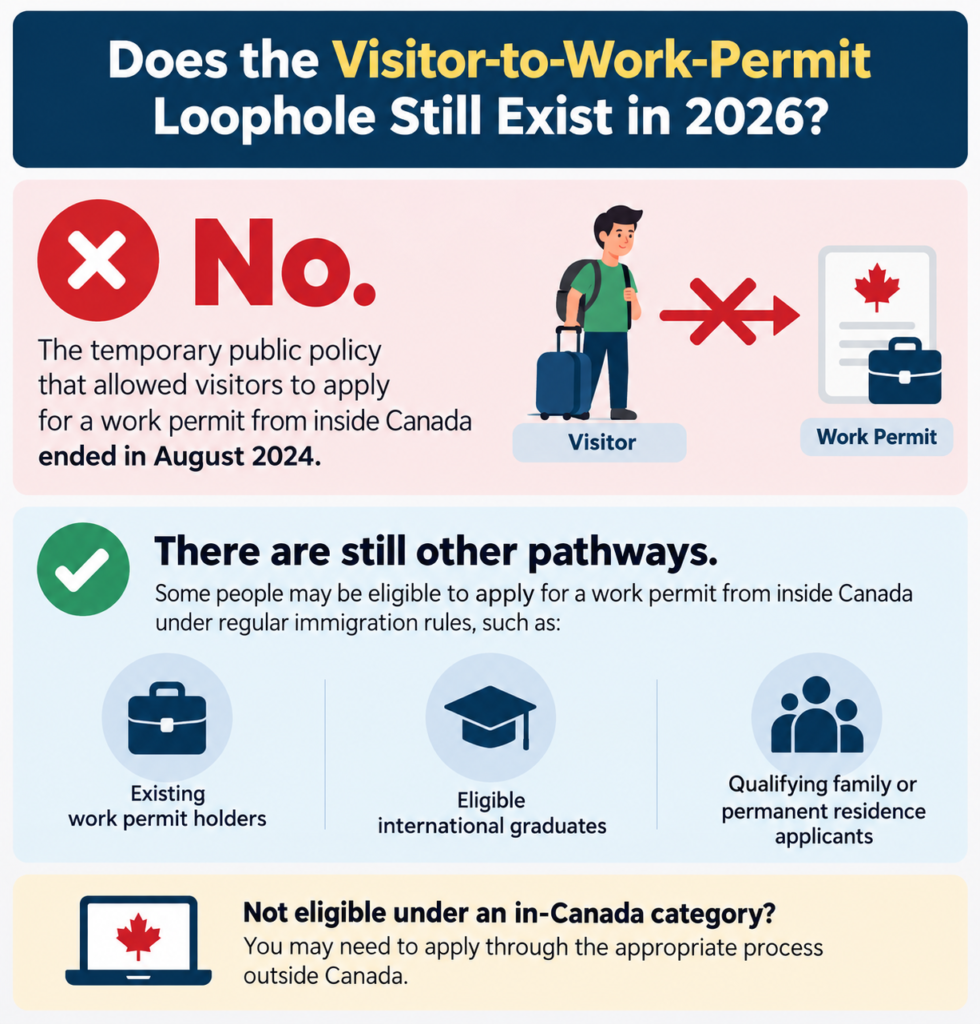
Does the Visitor-to-Work-Permit Loophole Still Exist in 2026?
No. The temporary public policy that provided this special route ended in August 2024.
A person cannot simply enter Canada as a visitor, receive a job offer, and use the discontinued policy to apply for an employer-specific work permit from inside the country.
However, Canada’s regular immigration rules still allow certain eligible individuals to apply for work permits while inside Canada. These are separate pathways with their own eligibility requirements.
For example, some existing work permit holders, eligible international graduates, and qualifying applicants in specific family or permanent residence categories may be eligible to apply from within Canada.
A visitor who does not qualify under any applicable in-Canada category may need to apply through the appropriate process outside Canada.
Therefore, the correct approach is to check your eligibility under current IRCC rules rather than rely on the idea of a general visitor-to-worker conversion.
Who Can Apply for a Work Permit From Inside Canada?
IRCC maintains a list of categories that may qualify for an in-Canada work permit application. Applicants must also meet the requirements of the specific work permit program.
The categories include the following.
1. People With a Valid Work or Study Permit
People who hold a valid Canadian work permit or study permit may qualify to apply for another work permit from inside Canada.
For example, a worker may need to apply for a new employer-specific work permit or a different type of authorization. An international student may qualify for a work permit under a program for which they meet the requirements.
Having a permit does not automatically guarantee approval. The applicant must satisfy the conditions of the intended work permit category.
2. Certain Family Members of Workers or Students
Some individuals may qualify to apply from inside Canada based on their relationship with a spouse, common-law partner, or parent who holds a qualifying work or study permit.
However, family-member work permit eligibility is subject to specific rules, which can depend on the principal applicant’s situation and immigration category.
Being married to a worker or student does not automatically make someone eligible for an open work permit.
3. Eligible Post-Graduation Work Permit Applicants
Certain international graduates may apply for a post-graduation work permit (PGWP) from inside Canada if they meet the applicable requirements.
Eligibility can depend on the study program, the institution, the student’s circumstances, and the relevant application deadline.
Graduates should confirm that they qualify before assuming that completing a Canadian educational program automatically provides permission to work.
4. Certain Permanent Residence Applicants
Some foreign nationals who are waiting for a permanent residence decision may qualify to apply for a work permit from inside Canada.
IRCC includes certain applicants in the spouse or common-law partner in Canada class and the overseas family class among the categories that may qualify, subject to the relevant conditions.
Other permanent residence pathways may have separate work permit provisions. Applicants should check the requirements that apply to their specific program.
5. Refugees and Other Eligible Categories
Certain recognized refugees, protected persons, refugee claimants, and people holding qualifying temporary resident permits may also be eligible under the applicable rules.
IRCC lists additional categories, including certain traders, investors, intra-company transferees, and professionals covered by the Canada–United States–Mexico Agreement.
These are specific eligibility categories, not general exceptions available to every visitor.
You can review the complete list on the official IRCC page for applying for a work permit from inside Canada.
Can a Visitor Get a Job Offer and Apply for a Work Permit?
A job offer can be an important part of a work permit application, but it does not automatically make a visitor eligible to apply from inside Canada.
Many employer-specific work permits require a qualifying job offer. Depending on the immigration program, the employer may also need a Labour Market Impact Assessment (LMIA), unless an applicable exemption exists.
Consider this example.
A person enters Canada as a visitor and receives an offer from a Canadian employer. The employer is willing to support a work permit application.
The person must still determine whether they qualify to submit the application from inside Canada. If they do not meet the applicable in-Canada eligibility rules, the job offer alone does not create an exception to those rules.
The employer’s willingness to hire someone and the applicant’s eligibility to obtain a work permit are two separate matters.
Before making employment arrangements, both parties should understand the relevant immigration requirements.
What Is the Difference Between an LMIA and a Work Permit?
An LMIA and a work permit serve different purposes.
A Labour Market Impact Assessment (LMIA) is an assessment that an employer may need before hiring a foreign worker through certain streams of Canada’s Temporary Foreign Worker Program. It generally considers the potential effect of hiring a foreign national on the Canadian labor market.
A work permit is the authorization that allows a foreign national to work in Canada under specified conditions.
An approved LMIA does not itself authorize someone to work. The worker must obtain the required work permit or other applicable authorization.
Some work permits are LMIA-exempt under specific programs, including certain categories under the International Mobility Program. Applicants must still meet the requirements of the relevant category.
Neither an LMIA nor an LMIA-exempt job offer automatically removes the rules governing where a work permit application can be submitted.
Can You Work While Your Work Permit Application Is Processing?
Visitors generally cannot work in Canada without authorization.
Submitting a work permit application does not automatically grant permission to begin working. Applicants should not assume they can start a job while waiting for IRCC to make a decision.
Certain eligible workers who apply to extend or change their work permit before their existing authorization expires may be allowed to continue working under maintained-status rules, subject to the applicable conditions.
This situation is different from that of a visitor who does not currently have permission to work.
The former temporary visitor-to-work-permit policy included a special provision for certain former work permit holders, but that policy ended in August 2024.
Before beginning employment, confirm that you have valid authorization to work in Canada. Unauthorized employment can have serious immigration consequences.
What Are the Legal Options for Visitors Who Want to Work in Canada?
If you are currently in Canada as a visitor and want to work, your options depend on your qualifications, immigration status, employment circumstances, and eligibility under the available programs.
Apply for a Work Permit From Outside Canada
If you do not qualify to apply from inside Canada, you may need to use the appropriate outside-Canada application process.
Depending on the program, this may involve obtaining a qualifying job offer, an LMIA where required, or evidence that you qualify for an LMIA-exempt work permit.
Review the relevant requirements before submitting an application or making travel arrangements.
Check Your Eligibility for an In-Canada Work Permit
Do not assume that you must leave Canada without first reviewing the applicable rules. Some foreign nationals qualify for an in-Canada application through an existing permit, a specific family category, a permanent residence pathway or another listed provision.
The eligibility requirements are specific, and visitor status alone is not sufficient.
Explore an Applicable LMIA-Exempt Category
Certain foreign nationals may qualify under an LMIA-exempt program, depending on their circumstances.
Examples can include qualifying professionals covered by international agreements and certain intra-company transferees. Each category has specific requirements, and not every applicant with a job offer qualifies.
Maintain Your Legal Status
If you are staying in Canada as a visitor, ensure that you comply with the conditions and duration of your authorized stay.
If you need to remain longer, you may be able to apply for an extension of visitor status before your current status expires, subject to the applicable rules.
An extension of visitor status does not grant permission to work. Visitors must continue to follow the conditions of their stay.
How Rajveer Chahal Education Consultant Can Help
Choosing an appropriate Canadian immigration pathway requires careful consideration of your current status, employment plans, qualifications, and eligibility.
Rajveer Chahal Education Consultant can help you understand the available options, review the documentation you may need, and identify questions that should be addressed before proceeding with an application.
Every case is different, and no consultant can guarantee a work permit approval. Applicants should verify current requirements with IRCC and ensure that anyone providing regulated immigration advice or representation is authorized to do so.
Frequently Asked Questions
Q1. Is the visitor-to-work-permit policy available in Canada in 2026?
Ans. No. IRCC ended the temporary public policy on August 28, 2024. Visitors cannot use that discontinued policy to apply for an employer-specific work permit from inside Canada.
Q2. Can I apply for a Canadian work permit while holding a visitor visa?
Ans. Some people may qualify to apply from inside Canada under separate eligibility rules. Visitor status alone does not establish eligibility. Others may need to apply from outside Canada.
Q3. Can I work in Canada if I have a job offer but only a visitor visa?
Ans. A job offer does not authorize you to work. You generally need a valid work permit or another legal authorization before starting employment.
Q4. Does an LMIA guarantee work permit approval?
Ans. No. An LMIA, when required, is one part of the process. The worker must also meet the applicable work permit requirements, and IRCC makes the final decision.
Q5. Can I extend my visitor status while exploring work permit options?
Ans. You may be able to apply to extend your visitor status if you meet the relevant requirements. However, visitor status does not authorize employment, and an extension does not automatically make you eligible for a work permit.
Conclusion
The visitor-to-work-permit policy that once allowed eligible visitors to apply for employer-specific work permits from inside Canada ended on August 28, 2024. It is no longer a general route for visitors seeking employment in 2026.
Other work permit pathways remain available to eligible individuals, but each has its own conditions. A job offer, an LMIA or a pending application does not automatically give a visitor permission to work.
The safest approach is to review current IRCC eligibility rules, maintain valid immigration status and choose a work permit pathway that matches your circumstances.


