


Turning 30 can make many people think about their future differently, especially if they are planning to move abroad. If permanent residence (PR) is one of your goals, you may be wondering whether your age will affect your chances in 2026.
The short answer is that turning 30 does not automatically make you ineligible for Canada PR. However, age is one of the factors that affects your Comprehensive Ranking System (CRS) score under Express Entry. As you get older, the points awarded for age decrease, which can affect your overall ranking.
The good news is that age is only one part of your immigration profile. Your education, language proficiency, work experience, and eligibility for different immigration programs also matter.
In this guide, we will explain how Canada PR after age 30 works in 2026, how age affects CRS points, and what you can consider when planning your immigration journey.
Is Canada PR After Age 30 Still Possible in 2026?
Yes, applicants over 30 can still qualify for Canadian permanent residence if they meet the requirements of an available immigration pathway.
There is no general rule under Express Entry that makes everyone ineligible once they turn 30. Instead, age affects the number of CRS points a candidate receives.
Express Entry manages applications for three federal economic immigration programs:
Each program has its own eligibility requirements. Meeting the minimum requirements of a program does not automatically guarantee an invitation to apply for permanent residence.
IRCC ranks eligible Express Entry candidates using the CRS and invites candidates through different rounds of invitations. The minimum score can vary between rounds.
This means applicants over 30 should look at both their eligibility and their overall profile rather than focusing only on their age.
How Does Age Affect Your CRS Score?
Age is one of the core human capital factors in the Express Entry Comprehensive Ranking System.
Candidates receive the maximum CRS age points between 20 and 29 years old. Once they turn 30, the age points begin to decrease.
The following table shows the age-factor points under the current CRS criteria.
CRS age points in 2026
| Age | With spouse | Without a spouse |
| 20–29 | 100 | 110 |
| 30 | 95 | 105 |
| 31 | 90 | 99 |
| 32 | 85 | 94 |
| 33 | 80 | 88 |
| 34 | 75 | 83 |
| 35 | 70 | 77 |
| 36 | 65 | 72 |
| 37 | 60 | 66 |
| 38 | 55 | 61 |
| 39 | 50 | 55 |
| 40 | 45 | 50 |
| 41 | 35 | 39 |
| 42 | 25 | 28 |
| 43 | 15 | 17 |
| 44 | 5 | 6 |
| 45 or older | 0 | 0 |
These figures represent age points only, not the total CRS score. The applicable column depends on whether you have an accompanying spouse or common-law partner under the CRS rules.
For example, a 30-year-old without an accompanying spouse receives 105 age points, compared with 110 points for someone aged 20–29.
At age 35, the same candidate receives 77 age points, and at age 40, they receive 50.
This shows why age should be considered when planning an Express Entry profile. However, the total CRS score includes several other factors, so the age points alone do not determine the result.
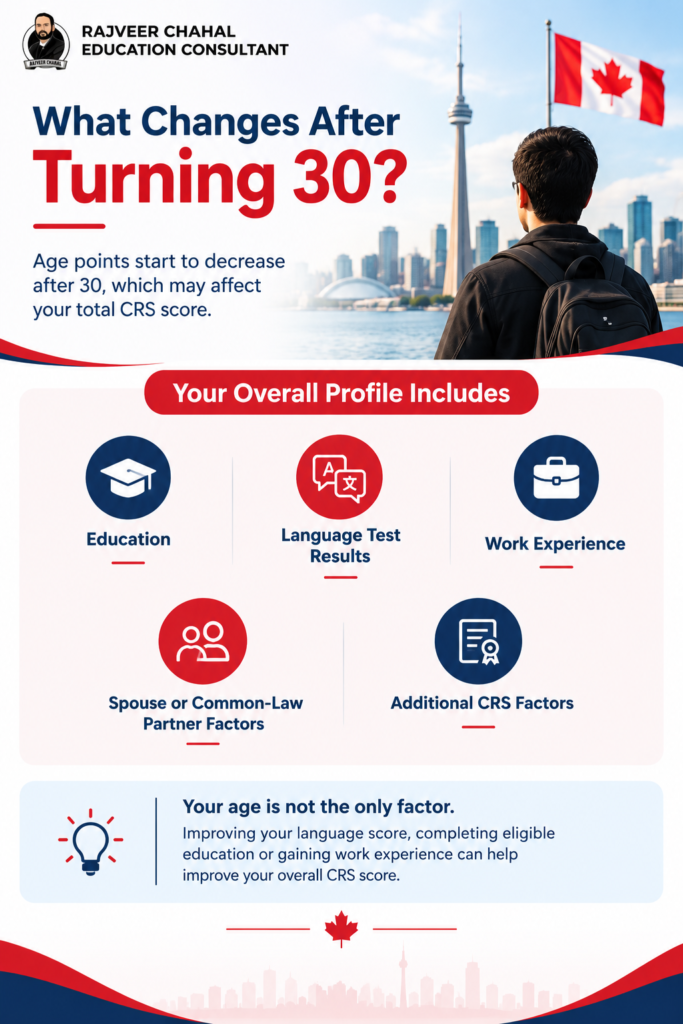
What Changes After Turning 30?
The main change is the gradual reduction in age points.
For some candidates, this reduction may have a limited effect on their total CRS score. For others, particularly those whose profiles are already close to a draw’s minimum score, even a small change may be important.
Your overall profile may include:
Your age is not the only part of the profile that can change. Improving language results, completing eligible education, or gaining qualifying work experience may affect other parts of your score, depending on your circumstances.
How to Strengthen Your Canada PR Profile After 30
If you are planning Canada PR after age 30, reviewing the parts of your profile that you can improve may help you understand your available options.
1. Improve your English language score.
Language proficiency can contribute significantly to your CRS score.
IRCC accepts approved language tests for Express Entry, including IELTS General Training, CELPIP-General, and PTE Core for English. Your results are converted into Canadian Language Benchmark (CLB) levels for assessment.
Higher language proficiency can contribute more CRS points and may also improve skill-transferability points when combined with qualifying education or work experience.
For example, achieving CLB 9 or higher across all four abilities can provide additional skill-transferability points for eligible candidates.
Before booking another test, review your current scores and identify which abilities need improvement.
2. Consider learning French.
French-language proficiency may be relevant for applicants who want to improve their Express Entry profile.
Candidates who meet the applicable French-language criteria may receive additional CRS points. Depending on their English results, eligible candidates can receive up to 50 additional points for French proficiency.
French-language ability may also be relevant to category-based Express Entry selection when candidates meet the current category requirements. However, learning French does not guarantee an invitation or permanent residence.
3. Review your education credentials.
Education is another important factor in Express Entry.
If you completed your education outside Canada, you may need an Educational Credential Assessment (ECA) to establish how your qualification compares with a Canadian credential for the relevant immigration purpose.
Your education level can contribute CRS points and may combine with language proficiency or work experience to contribute skill-transferability points.
Check whether your existing education is eligible for assessment before deciding whether additional education would be useful for your plans.
4. Build qualifying work experience
Work experience can affect both program eligibility and CRS points.
Depending on the immigration program, your occupation, duties, length of experience and other conditions may determine whether your work experience qualifies.
Canadian work experience can contribute CRS points. Foreign work experience may also contribute through skill-transferability factors when combined with qualifying language proficiency or Canadian experience.
It is important to understand that not every job or work experience automatically qualifies. Review the requirements of the program you intend to pursue.
5. Explore Provincial Nominee Programs
Provincial Nominee Programs (PNPs) allow participating provinces and territories to nominate eligible candidates under their immigration streams.
Some provincial pathways are connected to Express Entry, while others operate through separate application processes.
An eligible provincial or territorial nomination linked to Express Entry adds 600 CRS points. However, candidates must first meet the relevant provincial stream requirements, and nomination is not guaranteed.
Applicants over 30 may want to review provincial programs based on their occupation, qualifications, language results, and other eligibility criteria.
Which Canada PR Pathways Can Applicants Over 30 Explore?
Your age, work history, education, and current location may influence which immigration pathways are relevant to you.
Here are some options to research.
Express Entry
Express Entry is a system used to manage applications for the Federal Skilled Worker Program, Canadian Experience Class, and Federal Skilled Trades Program.
Applicants must meet the requirements of at least one program to enter the pool. Their CRS score is then used to rank them for invitations under applicable rounds.
Provincial Nominee Programs
PNPs have different eligibility requirements across provinces and territories. Some streams may focus on particular occupations, work experience, education, job offers, or other regional needs.
An applicant should review the exact stream requirements rather than assuming that one province’s criteria apply to another.
French-language selection
French-speaking candidates may wish to investigate French-language proficiency requirements and relevant Express Entry category-based rounds.
Selection criteria can change, so it is important to check the current IRCC instructions before making a plan based on a particular category.
Important: These pathways do not guarantee permanent residence. Eligibility, selection criteria, and invitation rounds should be checked using current official information.
Canada PR After 35 or 40: What Should You Consider?
Applicants aged 35 or 40 may have fewer CRS age points than younger candidates, but this does not automatically mean that they cannot qualify for Canadian permanent residence.
The impact of age depends on the rest of the profile and the immigration pathway.
For example, an applicant with strong language results, qualifying work experience, and an eligible provincial nomination will have a different profile from someone with limited language proficiency and no qualifying work experience.
At the same time, applicants should avoid assuming that improving one factor will necessarily make up for every point lost through age.
A practical starting point is to calculate your current CRS score, check your program eligibility, and investigate any relevant provincial or category-based options.
Common Mistakes Applicants Over 30 Should Avoid
When planning Canada PR after age 30, be careful not to rely on assumptions or outdated information.
Some common mistakes include:
Is Canada PR Worth Pursuing After Age 30?
Whether pursuing Canada PR is worthwhile after age 30 depends on your individual circumstances and goals.
Before making a decision, consider:
Age is one factor in the immigration process, but it is not the only one. Reviewing your complete profile can help you understand the options available to you and the requirements you would need to meet.
Conclusion
Canada PR after age 30 is still possible for applicants who meet the requirements of an available immigration pathway. Although CRS age points decrease as candidates get older, age alone does not determine the outcome of an application.
Language proficiency, education, qualifying work experience,
and provincial nomination options can all be relevant to an immigration profile.
If you are considering Canada PR in 2026, start by reviewing your eligibility and calculating your CRS score using the current official criteria. A clear understanding of your profile can help you make informed decisions about your next steps.
For personalized immigration guidance, contact Rajveer Chahal Education Consultant (RCEC) for a profile assessment.
Frequently Asked Questions (FAQs)
Q1. Can I apply for Canada PR after age 30 in 2026?
Yes. Turning 30 does not automatically make you ineligible for Canadian permanent residence. You must meet the requirements of the immigration program you are applying under.
Q2. How many CRS points do I get at age 30?
Under the current CRS age-factor table, a 30-year-old receives 95 points with an accompanying spouse or common-law partner and 105 points without an accompanying spouse or common-law partner.
Q3. Can I get Canada PR after age 35?
Applicants aged 35 may still qualify if they meet the requirements of an available immigration pathway. Their CRS age points are lower than those of younger candidates, but other factors also contribute to their profile.
Q4. Can French improve my Canada PR profile after 30?
French-language proficiency may provide additional CRS points and may be relevant to French-language category-based selection, provided the candidate meets the applicable requirements.
Q5. Does a provincial nomination help applicants over 30?
An eligible provincial or territorial nomination linked to Express Entry adds 600 CRS points. However, candidates must meet the relevant nomination requirements, and receiving a nomination is not guaranteed.