


Choosing the program in Canada has become more important for international students who want to work after they finish school. With changes to the Post-Graduation Work Permit (PGWP) rules, students can no longer assume that finishing any program at a designated learning institution (DLI) will automatically lead to a PGWP.
For 2026 there is one thing students should know: IRCC has frozen the PGWP field-of-study list for the entire year. This means IRCC will not add or remove fields of study during 2026. However, students still need to meet all PGWP requirements, including requirements related to their institution, program, language ability, and study history.
The current eligible fields are organized into categories including agriculture and agri-food, education, health care and social services, science, technology, engineering and mathematics (STEM), and trade and transport.
So what does the 2026 freeze mean, and how can students check whether their program qualifies?
What Is a Post-Graduation Work Permit?
The Post-Graduation Work Permit, commonly called a PGWP, allows eligible international graduates to gain work experience after completing their studies at an eligible institution.
The permit is valuable because it can give graduates the opportunity to gain work experience after their studies. That experience may also be useful for graduates considering Canadian immigration pathways depending on the requirements of the program they eventually pursue.
However, one important point is often misunderstood:
Graduating from a DLI does not automatically make a student eligible for a PGWP.
IRCC specifically states that students need to check whether their institution and program meet the PGWP requirements.
This is why checking the program before paying tuition or applying for a study permit is so important.
What Does the PGWP Field-of-Study Freeze Mean in 2026?
The term “PGWP list frozen” can sound confusing.
It does not mean that all PGWP rules are frozen.
Instead, IRCC has stated that during 2026 it will not add or remove fields of study from the PGWP field-of-study list.
The field-of-study requirement was introduced for students applying under the newer PGWP rules. The purpose is to connect non-degree programs with occupations and areas where Canada has identified longer-term labor shortages.
The list uses Canada’s Classification of Instructional Programs (CIP) system.
Therefore, students should not rely on the name of their course.
A program called “Business Technology,” “Computer Applications,” “Health Administration,” or another similar name may have a CIP code. The actual CIP code is what needs to be checked against the IRCC list.
The 2026 freeze provides certainty for students planning their studies this year, but it should not be interpreted as a guarantee of PGWP approval.
Who Needs to Meet the Field-of-Study Requirement?
Not every PGWP applicant needs to meet the field-of-study requirement.
According to IRCC, students generally do not need to meet this requirement if they graduated with a bachelor’s, master’s, or doctoral degree. Students who applied for their study permit before November 1, 2024, are also exempt from the field-of-study requirement. Certain flight school graduates have rules.
For students in university, college, polytechnic, or non-university programs, the field-of-study requirement can apply when the study permit application was submitted on or after November 1, 2024.
This distinction is extremely important. For example, a student completing a bachelor’s degree does not have to choose a program from the PGWP field-of-study list simply because they want a PGWP.
A student completing diploma or certificate programs, on the other hand, may need to graduate from an eligible field.
What Is a CIP Code?
One of the important terms students need to understand is CIP code.
CIP stands for Classification of Instructional Programs. It is a system used to classify secondary programs according to their field of study.
For purposes, IRCC uses six-digit CIP codes based on Canada’s 2021 CIP classification.
This means students should not make their decision based on a program title.
IRCC recommends checking the program’s CIP code through the institution, contacting the institution directly, or checking the Statistics Canada CIP classification catalogue. IRCC also warns that program titles can be broad, so students should read the description and applicable examples and exceptions.
A way to understand it:
College or university program → CIP code → Eligible field → PGWP field-of-study requirement
This is why two programs with similar names can potentially have different eligibility outcomes.
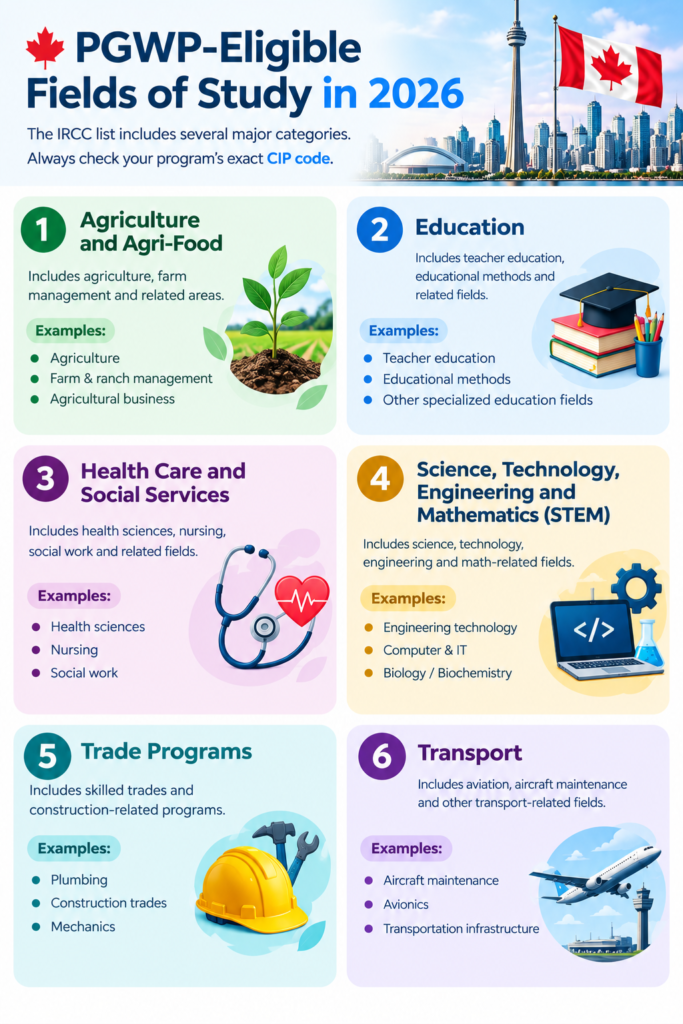
PGWP-Eligible Fields of Study in 2026
The current IRCC list is organized into several major categories. The list contains CIP codes, so students should always verify their exact program rather than assuming that an entire subject area is eligible.
1. Agriculture and Agri-Food
Agriculture and agri-food are among the areas on the current list.
Examples of fields appearing in the list include agriculture, agricultural business and management, farm and ranch management, agricultural mechanics, and other agriculture-related studies.
This category can be relevant to students in Canada’s agricultural sector, food production, farm management, agricultural technology, and related occupations.
However, students should remember that not every agriculture-related program automatically qualifies. The specific CIP code remains important.
2. Education
Education is another category included in the eligible fields.
The current list contains education-related CIP codes, including areas connected with teacher education, educational methods, and other specialized education fields.
Students interested in education should therefore check their program classification rather than relying solely on terms such as “education,” “teaching,” or “teacher training.”
The program’s actual CIP classification needs to match a code under the applicable rules.
3. Health Care and Social Services
Health care and social services represent another group in the PGWP field-of-study list.
The current list includes a range of health-related and social-service fields. Examples include health sciences, health and wellness, medical and clinical assistance, pharmacy technician-related studies, nursing education, social work, and other specialized health-related programs.
This category is particularly important because Canada’s labor market needs have been one of the factors behind the expansion and adjustment of fields.
However, students should be careful about using a statement such as “all healthcare programs are PGWP eligible.”
That is not accurate.
A student’s specific program and CIP code must be checked against the IRCC requirements.
4. Science, Technology, Engineering, and Mathematics (STEM)
STEM is one of the important categories for international students.
The eligible list includes science, technology, engineering, and mathematics-related fields.
Examples found on the list include engineering technology, computer engineering technology, computer systems technology, robotics technology, biomedical technology, biology, biochemistry, molecular biology, and other specialized STEM areas.
Students considering technology or computer-related programs should pay attention to the CIP code.
Simply having words such as “computer,” “technology,” “IT” or “data” in a program name does not mean the program automatically meets the field-of-study requirement.
The exact classification should be confirmed before making a study decision.
5. Trade Programs
Trade-related programs are also represented on the list.
Examples include plumbing, construction trades, mechanics, electrical and electronics equipment installation and repair, cooking and culinary-related programs, agricultural mechanics, and construction project management.
These programs can be attractive to students looking for career-focused education.
Once again students should verify the exact CIP code rather than assuming that every trade program is eligible.
6. Transport
Transport is another category included in the list.
Eligible examples include transportation infrastructure studies, aircraft maintenance-related programs, airframe mechanics, aircraft powerplant technology, avionics maintenance, and other transport-related fields.
Students considering aviation and transportation programs should also review the rules that may apply to flight-school graduates.
IRCC states that graduates of PGWP flight schools have different requirements and are not subject to the usual language or field-of-study requirements applicable to many other graduates.
Are Business Programs PGWP Eligible in 2026?
This is one of the questions among international students.
The answer is: do not assume that a general business program qualifies under the field-of-study requirement.
Students should check the program and CIP code.
The fact that a college or university offers a business diploma does not automatically mean that the program satisfies the PGWP field-of-study requirement for students who’re subject to that requirement.
At the time students graduating from bachelor’s, master’s, or doctoral programs are treated differently because IRCC does not impose the field-of-study requirement on those degree graduates.
Therefore, students need to look at their level of study, study permit application date, and specific program rather than asking whether “business” as a whole is eligible.
Are Computer and IT Programs Eligible for PGWP?
Computer and technology programs are another choice among international students.
Several computer and technology-related CIP codes appear in the eligible list. These include areas such as computer engineering technology, computer systems technology, robotics technology, and other STEM-related fields.
Again, the program title is not enough.
Before selecting a course, students should ask the institution for the six-digit CIP code. Verify that code against IRCC’s current list.
This is especially important because colleges can use names for programs that appear similar.
Other PGWP Requirements Students Should Know
The field-of-study requirement is one part of PGWP eligibility. PGWP,
IRCC says that people applying need to meet all the rules that apply. Usually the student has to finish a program that is allowed for a PGWP at a school that is allowed for a PGWP, and the program must meet the time rules.
Language rules also apply to people applying for a PGWP now.
For people with bachelor’s, master’s, or doctorate degrees, IRCC asks for proof of English or French at CLB 7/NCLC 7 in all four areas. For people with university programs, the same CLB/NCLC 7 level applies. People with college, technical school, or other non-university programs usually need CLB 5/NCLC 5 in all four areas.
This means picking a program that is allowed is important. Students also need to get ready for the language part.
How Long Can a PGWP Be?
How a PGWP can be depends on the program and other things, including the passport being valid.
For programs that are eight months or more but less than two years, the PGWP may be given for the same time as the study program.
Programs that are two years or longer might get a PGWP for up to three years if all the rules are met.
There is also a rule for people who finished a master’s program.
A master’s graduate might get a three-year PGWP even if the master’s program was less than two years as long as the program was at least eight months or 900 hours for programs in Quebec and the person meets other rules.
How to Check Your Program Before Applying
If you plan to study in Canada in 2026, don’t depend on a college ad or an old article.
Do these steps:
Step 1: Find the name of your program.
Step 2: Ask the school that is allowed for a PGWP for the program’s six-digit CIP code.
Step 3: Look at the CIP code. Compare it with the current list from IRCC that shows eligible programs.
Step 4: Check if the date you applied for your study permit makes the field-of-study rule apply to you.
Step 5: Check the language rule.
Step 6: Make sure the school and program meet rules for a PGWP.
IRCC says to contact the school if you’re not sure about the CIP code of the program.
Common Mistakes Students Should Avoid
One of the mistakes is thinking that “PGWP eligible school” means every program at that school is allowed.
That is not always true.
Other common mistakes include:
These mistakes can cost a lot of time and money because students might spend a lot on a program and find out later that they don’t meet the rules.
What Does the 2026 Freeze Mean for Students?
The 2026 freeze gives students some more certainty.
IRCC says that eligible fields of study will not be added or removed during 2026.
That makes the current list very important for students planning to study during the year.
The freeze should not be seen as a promise that a PGWP will be approved.
A student still has to meet the rules about the school, the program, language skills, study history, and other things.
In words, the right field is important, but it is only one part of the PGWP puzzle.
Need Help Choosing a PGWP-Eligible Program in Canada?
Choosing the right Canadian program can be confusing, especially with the updated PGWP rules and field-of-study requirements. Rajveer Chahal Education Consultant can help you understand your study options, check program suitability, review your profile and guide you through the Canada study visa process.
Our team can assist with course and college selection, profile assessment, documentation, application preparation and study visa guidance. We can also help you understand important PGWP-related considerations before you finalize your program.
If you are planning to study in Canada in 2026, getting your program and application strategy reviewed before applying can help you make a more informed decision.
Start your Canada study journey with Rajveer Chahal Education Consultant.
Frequently Asked Questions
Q1. What are the programs that are eligible for a PGWP in 2026?
Ans. Eligibility for a PGWP depends on the person’s situation. When the field-of-study rule applies, the program’s six-digit CIP code. Eligible fields now include agriculture and food education, health and social services, STEM, and trade and transport.
Q2. Is the list of fields of study for a PGWP frozen in 2026?
Ans. Yes. IRCC says they will not add or remove fields of study during 2026.
Q3. Do people with bachelor’s degrees need a field of study?
Ans. No. Graduates with bachelor’s, master’s, or doctorate degrees don’t have to meet the field-of-study rule for a PGWP. Other rules for a PGWP still apply.
Q4. What is a CIP code?
Ans. A CIP code is a six-digit code used to identify a secondary field of study. IRCC uses CIP codes when applying the field-of-study rule for a PGWP.
Q5. Are all computer programs for a PGWP?
Ans. No. Students should check the program’s CIP code against IRCC’s list instead of just looking at the program title.
Q6. Are all business programs allowed?
Ans. Students should not think all business programs meet the field-of-study rule. The specific program, CIP code, and the person’s situation must be checked.
Q7. How long can a PGWP be?
Ans. A PGWP can usually be valid for eight months up to three years depending on the program and other things. People with a master’s program might get three years even if the program was shorter than two years.
Q8. Do I need a test for English or French for a PGWP?
Ans. Most people applying now need to show they can speak English or French. The level needed depends on the program they finished.
Q9. Does studying at a school that is allowed for a PGWP guarantee a PGWP?
Ans. No. IRCC says that graduating from a school that is allowed for a PGWP does not automatically make a graduate eligible for a PGWP.
Q10. Where can I check if my program is eligible for a PGWP?
Ans. Students should look at the list from IRCC and check the program’s six-digit CIP code with the school.
Final Thoughts
The list of programs that are eligible for a PGWP in 2026 is very important for international students who are choosing a Canadian diploma, certificate, or other non-degree programs.
The good news is that IRCC has frozen the list of fields for 2026 so those fields will not change during the year.
Students should look past just the label that says “PGWP eligible.”
Before choosing a Canadian program, check the school, the program, the CIP code, the date you applied for your study permit, the language rules, and other PGWP rules. A program title alone is not enough to know if it is allowed.
For students planning their study journey in Canada, taking time to check these details before applying can help avoid a mistake later.
If you are not sure if a specific Canadian program fits your study and, after-graduation plans it is better to check with the school and compare the CIP code with the current IRCC information before making a final decision.