

If you are planning to apply for permanent residence in Canada in 2026, you have probably come across two names again and again: Express Entry and the Provincial Nominee Program (PNP).
At first glance, Express Entry may look like the simpler option. You create a profile, enter the pool and wait for an Invitation to Apply (ITA). PNP, on the other hand, involves a province or territory selecting you before you move forward with your permanent residence application.
But there is an important part of the story that is easy to miss.
PNP and Express Entry are not always two completely separate immigration systems. Some PNP streams are connected to Express Entry, while others operate outside it.
The situation is particularly interesting in Ontario in 2026 because the Ontario Immigrant Nominee Program (OINP) has been redesigned. Several older streams have been closed, and Ontario has introduced a new workforce-focused structure.
So, PNP vs Express Entry 2026: which one is actually faster?
There is no single answer for everyone. If your CRS score is already strong enough to receive an ITA, direct Express Entry may be the simpler route. If your CRS score is not competitive, a provincial nomination could significantly improve your chances or provide another route to permanent residence.
Let’s look at how the two options compare and what Ontario’s 2026 changes mean for applicants.
Express Entry vs PNP: What Is the Difference?
The easiest way to understand the difference is to look at who is selecting you.
Express Entry is Canada’s federal system for managing applications under several economic immigration programs. Candidates create an Express Entry profile and receive a CRS score based on factors such as age, education, language ability and work experience.
IRCC then invites eligible candidates to apply for permanent residence through invitation rounds.
The Provincial Nominee Program, meanwhile, allows provinces and territories to nominate people who meet their specific economic and labour-market requirements.
Each province has its own programs and selection criteria.
This means that someone who is not competitive enough in the federal Express Entry pool may still have an opportunity through a suitable provincial program.
What Is Express Entry in 2026?
Express Entry manages applications for three main federal economic immigration programs:
It also works with certain provincial nominee streams.
Your Express Entry profile is placed into a pool with other eligible candidates. Your CRS score determines your ranking in applicable rounds, although IRCC can also conduct category-based rounds targeting candidates with particular skills, occupations or characteristics.
The important thing to remember is that creating an Express Entry profile does not guarantee an ITA.
That waiting period can make a major difference when you are comparing immigration timelines.
What Is a Provincial Nominee Program?
The PNP gives Canadian provinces and territories a way to select immigrants who can contribute to their local economies.
For example, a province may look for candidates with:
The requirements vary considerably from one province to another.
There are also two broad types of PNP applications:
Express Entry-linked PNP: The provincial nomination works with your Express Entry profile.
Non-Express Entry PNP: The provincial nomination follows a separate process before the federal permanent residence application.
This distinction is extremely important when discussing PNP processing times.
Why Does an Express Entry PNP Nomination Matter?
One of the biggest advantages of an Express Entry-linked provincial nomination is the CRS benefit.
An eligible provincial nomination gives an Express Entry candidate 600 additional CRS points.
For someone whose CRS score is too low to be competitive in a particular federal draw, those additional points can completely change their position in the pool.
The process can look like this:
Provincial eligibility → nomination → 600 CRS points → ITA → PR application
However, getting the nomination itself takes time. Therefore, the 600 points are a major advantage, but they do not necessarily mean the overall process will be faster.
What Has Changed in Ontario in 2026?
This is where applicants need to be careful.
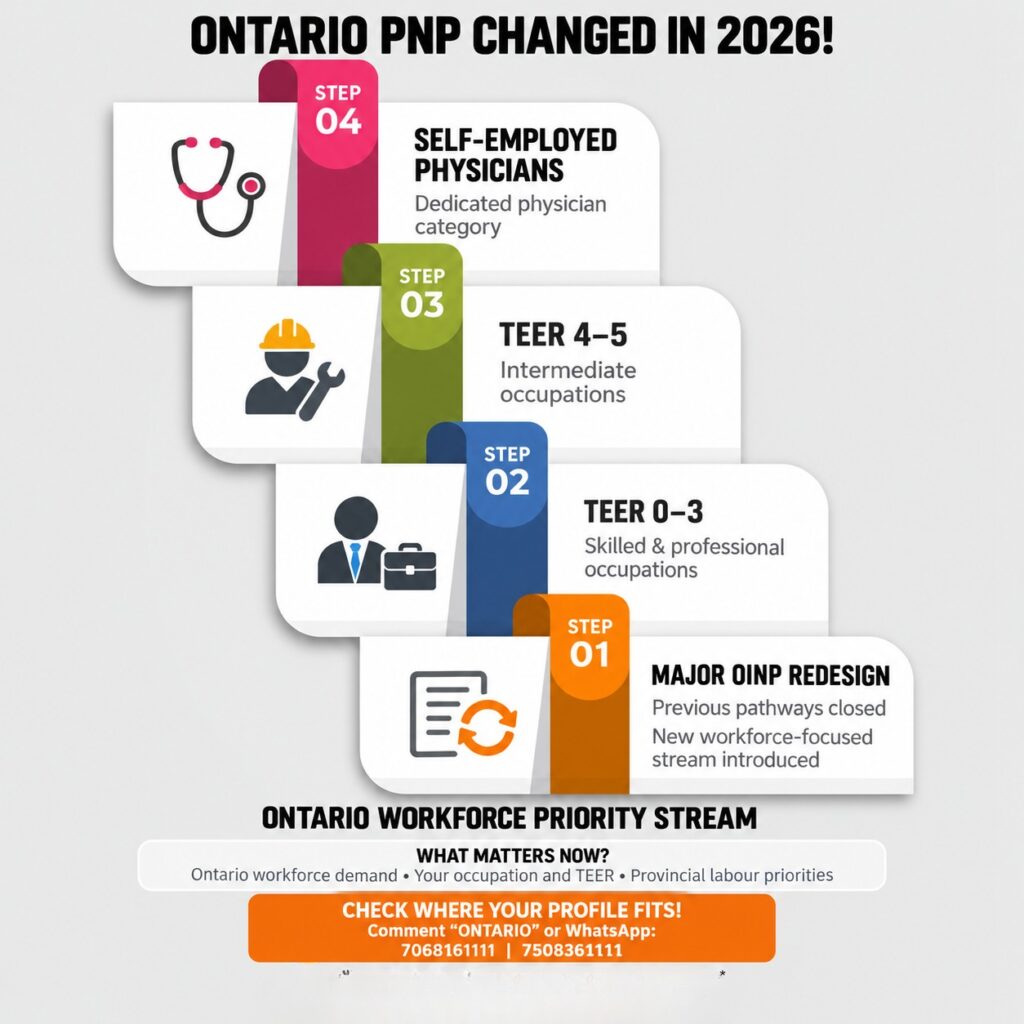
Ontario has made major changes to the Ontario Immigrant Nominee Program (OINP) in 2026.
The province closed several previous OINP pathways and introduced the Ontario Workforce Priority Stream as part of its redesigned approach.
The new structure includes three categories:
The redesign places greater emphasis on Ontario’s workforce requirements and candidates who can help address provincial labour-market needs.
As a result, older articles discussing Ontario’s previous Human Capital Priorities, French-Speaking Skilled Worker or Skilled Trades streams should not automatically be used to plan a 2026 application.
The eligibility rules and stream structure need to be checked against the current OINP requirements.
Is Ontario PNP Still Connected to Express Entry?
This is one of the most common questions applicants have.
Ontario previously operated several Express Entry-linked streams. However, the 2026 redesign changed that structure.
The former Express Entry-linked Human Capital Priorities, French-Speaking Skilled Worker and Skilled Trades streams were closed under the new OINP framework.
The current Ontario Workforce Priority categories are designed around Ontario’s workforce priorities and have their own eligibility requirements.
So, having an Express Entry profile does not automatically mean you can receive an Ontario nomination.
You need to qualify under an available Ontario pathway and meet its specific requirements.
PNP vs Express Entry 2026: Which Is Faster?
Now we come to the question most applicants actually want answered.
Express Entry Can Be Faster If Your CRS Is Strong
Suppose you already have a competitive CRS score.
You create your Express Entry profile, receive an ITA relatively quickly, and submit your permanent residence application.
In that situation, going directly through Express Entry can be more efficient because you are not waiting for a province to nominate you first.
The basic journey is:
Express Entry profile → ITA → PR application → IRCC processing
There is no separate provincial nomination stage.
However, this only works if your profile is competitive enough to receive an ITA.
PNP Can Be the Better Option If Your CRS Is Low
Now consider someone with a lower CRS score.
They may qualify for Express Entry but have little chance of receiving an ITA in the federal round they are targeting.
If that person qualifies for a suitable PNP stream, the provincial nomination could provide a much stronger immigration strategy.
For an Express Entry-linked nomination, the additional 600 CRS points can make receiving an ITA much more achievable.
The trade-off is that the applicant must first complete the provincial process.
So PNP can involve more steps, but it may get you to the ITA stage when direct Express Entry cannot.
2026 Comparison: PNP vs Express Entry
| Factor | Direct Express Entry | PNP |
| Selection | Federal | Provincial/territorial |
| CRS required | Yes | Depends on stream |
| Provincial nomination | No | Yes |
| 600 CRS points | No | Yes, for Express Entry-linked nominations |
| Job offer | Not always required | Depends on the PNP |
| Provincial requirements | No | Yes |
| Federal PR application | Yes | Yes |
| Separate provincial stage | No | Usually yes |
| Best suited for | Competitive Express Entry profiles | Candidates who meet provincial priorities |
The right option depends much more on your profile than on the name of the program.
What Are the PNP Processing Times in 2026?
Processing times should be treated carefully because IRCC updates them regularly and they can change as application volumes and inventories change.
Recent 2026 IRCC figures have shown approximately:
But these numbers represent the federal processing stage.
They do not necessarily represent the entire time from the day you start your immigration plan to the day you become a permanent resident.
For a PNP applicant, you may first need to:
- Meet the provincial eligibility requirements
- Submit an Expression of Interest or application, where applicable
- Receive an invitation or provincial selection
- Submit the provincial application
- Obtain the nomination
- Complete the federal PR application
- Wait for IRCC’s decision
This is why simply saying “PNP takes seven months” can give applicants the wrong impression.
How Long Does Express Entry Take?
Express Entry also has more than one stage.
Before you even enter the pool, you may need to arrange:
After creating your profile, you may need to wait for an ITA.
Once you receive the ITA, you have a limited period to submit your complete application.
The federal processing time then applies to the PR application after submission.
Therefore, an Express Entry processing time should not be confused with the total time needed to receive an ITA.
Who Should Consider Express Entry First?
Direct Express Entry may make sense if you have a strong overall profile.
You may want to consider it first if you have:
In this situation, adding a provincial stage may not be necessary if you can reasonably expect an ITA through Express Entry.
Who Should Look at PNP Options?
PNP may deserve more attention if your CRS score is not competitive.
It can also be worth exploring if:
For Ontario applicants, the new 2026 workforce-focused structure makes it especially important to examine the current OINP categories rather than older program information.
Does a Job Offer Make PNP Faster?
Not automatically.
A job offer can be important for certain PNP streams and may make a candidate eligible for a provincial pathway.
But having a job offer does not mean the nomination or PR application will automatically be processed faster.
The actual timeline depends on the particular program, application volume, provincial processing, IRCC processing and whether the application is complete.
It is better to think of a job offer as an eligibility or selection factor, rather than a guaranteed processing-time advantage.
Does PNP Guarantee Permanent Residence?
No.
A provincial nomination is an important step, but it is not the same as receiving Canadian permanent residence.
After nomination, the federal government still assesses the permanent residence application.
Applicants must meet the applicable federal requirements and admissibility criteria.
So even with a provincial nomination, the final PR decision is made by IRCC.
What About Ontario’s New Workforce Priority Stream?
For people specifically interested in Ontario, this is one of the most important areas to understand in 2026.
The Ontario Workforce Priority Stream is designed to help Ontario respond to workforce needs.
Its categories cover different TEER levels and self-employed physicians.
The requirements can include factors such as:
Because the program is new, applicants should use the current Ontario government requirements rather than copying eligibility information from older OINP blogs.
PNP vs Express Entry 2026: Which One Should You Choose?
There is no universal winner.
Think about it this way:
If your CRS is already competitive:
Direct Express Entry may be the simpler and potentially faster route.
If your CRS is not competitive:
A suitable PNP may give you a much stronger chance of progressing toward an ITA or PR.
If you have an eligible Ontario job offer:
The redesigned OINP may be worth examining carefully.
If you do not qualify for a current provincial stream:
A PNP should not be treated as a backup option simply because your CRS is low. You must actually meet the province’s requirements.
The best pathway is the one that you are genuinely eligible for and that gives you a realistic route forward.
How to Decide Between PNP and Express Entry in 2026
Before choosing a pathway, review these six areas of your profile:
1. CRS Score
Calculate your CRS score accurately and determine whether your profile is competitive.
2. Occupation
Check your occupation, NOC and TEER classification and compare them with current federal and provincial requirements.
3. Work Experience
Your work experience can affect both Express Entry eligibility and provincial eligibility.
4. Language Score
English or French language results can have a significant impact on your immigration profile.
5. Job Offer
If you have a Canadian or Ontario job offer, check whether it satisfies the requirements of the specific program.
6. Province
Do not choose a PNP simply because it appears faster.
You should qualify for the program and genuinely intend to establish yourself in the nominating province where the program requires that intention.
How Rajveer Chahal Education Consultant Can Help
Choosing between PNP vs Express Entry 2026 requires more than simply comparing processing times.
Your age, education, language scores, work experience, occupation, CRS score, job offer and immigration goals can all affect which pathway makes sense.
Rajveer Chahal Education Consultant provides guidance for Canada immigration and permanent residence pathways, including profile assessment, documentation guidance and application support.
If you are considering Ontario after the 2026 OINP redesign, it is particularly important to review the current program requirements before making an application strategy.
Frequently Asked Questions
Is PNP faster than Express Entry in 2026?
Not necessarily. Direct Express Entry can be faster for someone who already has a competitive CRS score and receives an ITA. PNP can be more useful for candidates who need a provincial nomination to become competitive or qualify through a provincial pathway.
Does PNP give 600 CRS points?
An Express Entry-linked provincial nomination gives 600 additional CRS points. This does not apply in the same way to non-Express Entry PNP applications.
Can I apply for Express Entry without a PNP?
Yes. If you meet the requirements of an eligible Express Entry program, you can create an Express Entry profile without a provincial nomination.
Is Ontario PNP available in 2026?
Yes. Ontario continues to nominate immigrants through its redesigned OINP framework. The province introduced the Ontario Workforce Priority Stream in 2026.
What happened to Ontario’s old Express Entry PNP streams?
Ontario closed the previous Human Capital Priorities, French-Speaking Skilled Worker and Skilled Trades Express Entry-linked streams as part of its 2026 redesign.
Does a low CRS score mean I should apply for PNP?
Not automatically. You should first identify whether you actually qualify for an available PNP stream. A low CRS score by itself does not make someone eligible for a provincial nomination.
Does an Ontario job offer guarantee a PNP nomination?
No. A job offer may be required or relevant for a particular OINP category, but applicants must meet all applicable eligibility requirements and receive a nomination from Ontario.
Does a provincial nomination guarantee PR?
No. The province nominates the candidate, but IRCC makes the final decision on the permanent residence application.
Which is better for Canada PR in 2026: PNP or Express Entry?
Neither is universally better. Express Entry may be preferable for a candidate with a competitive CRS score, while PNP may be more suitable for someone who qualifies for a provincial stream and needs a nomination to strengthen their immigration pathway.
Can immigration processing times change after I apply?
Yes. IRCC processing times are estimates and can change as application volumes, inventories, program priorities and processing capacity change.
Final Thoughts
The debate over PNP vs Express Entry 2026 should not be reduced to a simple question of which program has the shorter processing time.
The bigger question is: Which pathway gives you the most realistic route to permanent residence based on your profile?
For a strong Express Entry candidate, going directly through the federal system may be the simplest option.
For someone with a less competitive CRS score but a profile that fits a provincial labour-market need, PNP can be extremely valuable.
Ontario’s 2026 redesign makes this even more important. The old OINP stream structure is no longer a reliable guide for new applicants, and the current Ontario Workforce Priority categories need to be assessed on their own requirements.
Before choosing a pathway, check the latest IRCC and Ontario requirements and evaluate your complete profile rather than choosing a program based only on an advertised processing time.