

If you are planning to apply for a Canada study permit, work permit, visitor visa, Super Visa or permanent residence, one of the first questions you may have is: How long will IRCC take to process my application?
The IRCC Processing Times Dashboard 2026 provides estimated processing times for different immigration and temporary-residence applications. However, these timelines are not fixed. IRCC updates temporary-residence estimates regularly, while permanent-residence and citizenship processing times are generally updated monthly.
The September 2026 updates show a mixed picture. Some applications are moving relatively quickly, while other categories continue to experience long waits. For example, study permit processing for applicants from India is currently around 5 weeks, while visitor record extensions inside Canada are around 403 days. In permanent residence, the Federal Skilled Worker Program is at 7 months, while some programs such as the Start-Up Visa and Federal Self-Employed Persons Program have processing times exceeding 10 years.
This guide explains the latest IRCC Processing Times Dashboard 2026 figures, what is moving faster, which categories have significant backlogs and how applicants should interpret these estimates.
What Is the IRCC Processing Times Dashboard?
The IRCC processing-times tool is the official Government of Canada tool used to estimate how long different immigration and citizenship applications may take to process.
The processing time depends on the application type and, for many temporary-residence applications, the country from which the application is submitted.
IRCC processing times can be calculated using different methods. Historical processing times generally reflect how long it took to finalize most comparable applications, while forward-looking estimates consider factors such as the current inventory and available processing capacity.
Most importantly, a processing time is an estimate, not a guarantee.
An application can take less time or more time than the published estimate depending on its circumstances.
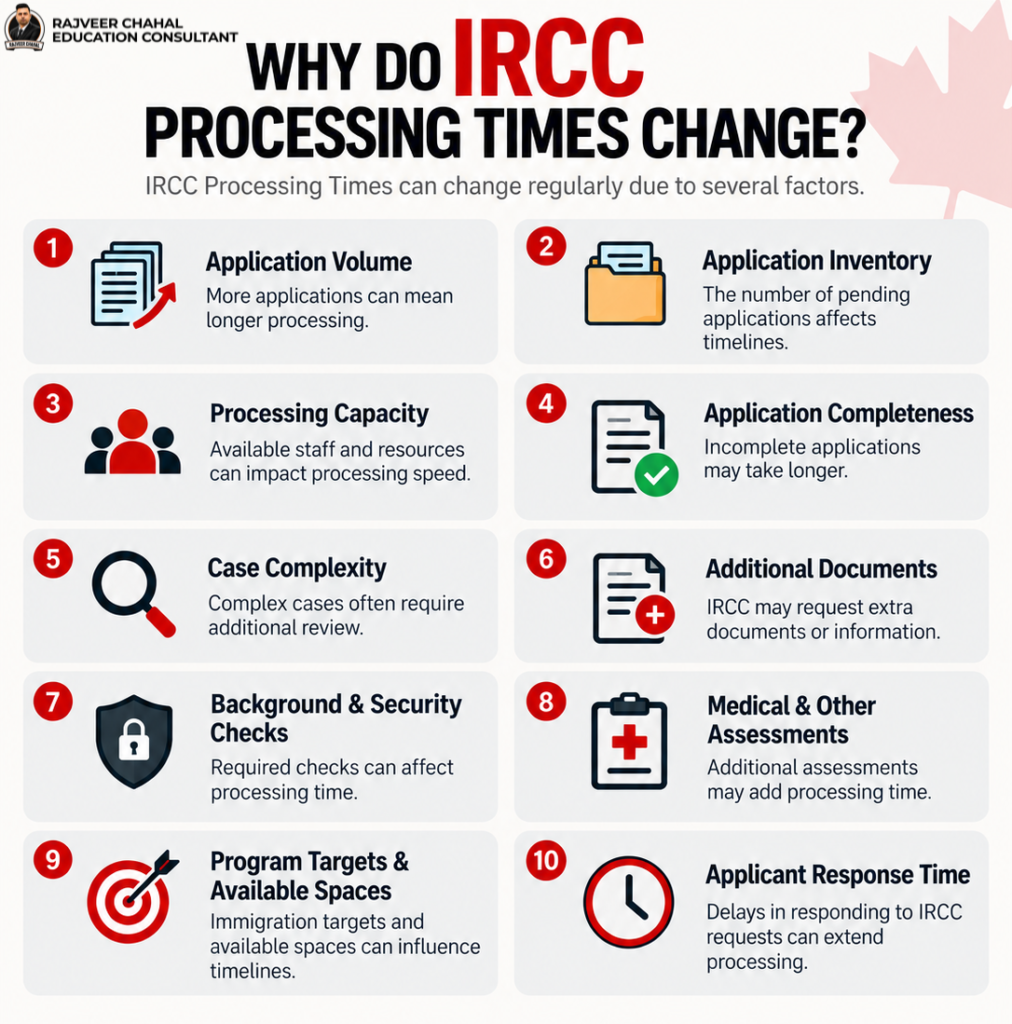
Why Do IRCC Processing Times Change?
The IRCC Processing Times Dashboard 2026 changes because immigration processing is affected by several factors.
These include:
Temporary-residence processing estimates can change from one week to the next. Therefore, an applicant should always check the current IRCC tool instead of relying on an old screenshot or processing-time table.
September 2026 Temporary Residence Processing Times
IRCC’s temporary-residence processing estimates were updated on September 9, 2026.
The latest figures show that processing times differ considerably depending on where the application is submitted.
Study Permit Processing Times
For applicants from India, the current study permit processing estimate is approximately 5 weeks.
The September 9 figures for selected countries are:
| Applying From | Study Permit |
| India | 5 weeks |
| Pakistan | 7 weeks |
| Nigeria | 9 weeks |
| United States | 6 weeks |
| Philippines | 5 weeks |
| Inside Canada | 7 weeks |
For Indian applicants, the 5-week estimate is considerably shorter than many of the longer temporary-residence categories.
However, students should not treat five weeks as a guaranteed decision date. IRCC can request additional documents or information, and processing times can change.
Work Permit Processing Times
Work permit processing also varies according to the applicant’s location.
As of the September 9 update:
| Applying From | Work Permit |
| India | 10 weeks |
| Pakistan | 8 weeks |
| Nigeria | 10 weeks |
| United States | 2 weeks |
| Philippines | 7 weeks |
| Inside Canada | 110 days |
The in-Canada work permit figure is particularly important because it has been trending downward during 2026.
Applicants should remember that different work permit situations can have different processing times. A person applying for a new work permit from outside Canada should not automatically use the timeline for an application submitted from inside Canada.
Visitor Visa Processing Times
Visitor visa processing times can also vary significantly by country.
The September 9 figures for selected countries were:
| Applying From | Visitor Visa |
| India | 31 days |
| United States | 18 days |
| Pakistan | 73 days |
| Nigeria | 84 days |
| Philippines | 19 days |
| Inside Canada | 11 days |
This shows why there is no single “Canada visitor visa processing time.”
For example, an applicant from India and an applicant from Pakistan may see very different processing estimates at the same time.
Applicants should therefore select the correct country when checking the IRCC processing-time tool.
Super Visa Processing Times
Super Visa applications can also have substantially different processing times depending on the applicant’s location.
The September 9 estimates were:
| Applying From | Super Visa |
| India | 69 days |
| United States | 66 days |
| Nigeria | 44 days |
| Pakistan | 132 days |
| Philippines | 64 days |
Super Visa applications must be submitted from outside Canada.
For Indian applicants, the current estimate is approximately 69 days.
Processing times can change weekly, so families planning to bring parents or grandparents to Canada should check the current IRCC estimate before making travel plans.
Visitor Record Extension: One of the Major Backlogs
One of the clearest examples of a long processing timeline is the visitor record extension.
As of September 9, 2026, the estimated processing time was approximately
403 days
That is more than one year.
This is very different from the visitor visa processing estimate, which can be measured in days for some countries.
A visitor visa and a visitor record are not the same application.
A visitor record is used to extend or change the conditions of a person’s stay in Canada. Applicants should therefore make sure they select the correct application category when checking processing times.
Permanent Residence Processing Times in September 2026
Permanent residence processing times were updated on September 3, 2026.
The latest figures show that some economic immigration programs remain within approximately a year, while several other programs have much longer waits.
Express Entry
The September 2026 estimates include:
| Program | Processing Time |
| Canadian Experience Class (CEC) | 6 months |
| Federal Skilled Worker Program (FSWP) | 7 months |
| Federal Skilled Trades Program (FSTP) | N/A |
IRCC does not currently publish a processing-time estimate for the Federal Skilled Trades Program because there is not enough data.
The Federal Skilled Worker Program increased from 6 months to 7 months, while the Canadian Experience Class remained at 6 months.
Applicants should understand that these are processing-time estimates after the permanent residence application has been submitted. They do not represent the entire Express Entry journey, which can also include creating a profile, receiving an Invitation to Apply and preparing the permanent residence application.
Provincial Nominee Program Processing Times
Provincial Nominee Program processing times depend on whether the nomination is connected to Express Entry.
The September 2026 estimates are:
The difference is significant.
Therefore, applicants should identify whether they are applying through an Express Entry-linked provincial nomination or a base/non-Express Entry pathway before estimating their processing time.
Spousal Sponsorship Processing Times
Family sponsorship processing has also changed during 2026.
As of September 3, 2026, for applicants outside Quebec:
For Quebec, the timelines are different:
These figures demonstrate why applicants should never use a generic “Canada spouse visa processing time” without checking whether the application is inside or outside Canada and whether the destination is Quebec.
Which Applications Are Most Backlogged?
The IRCC Processing Times Dashboard 2026 shows that some programs have considerably longer processing times than others.
Visitor Record Extensions
Approximately 403 days.
Spousal Sponsorship Inside Canada
Approximately 26 months outside Quebec.
Spousal Sponsorship Outside Canada
Approximately 18 months outside Quebec.
Parents and Grandparents Program
Approximately 28 months outside Quebec.
Quebec Parents and Grandparents
Approximately 63 months.
Atlantic Immigration Program
Approximately 26 months.
Start-Up Visa Program
Processing time remains 10+ years.
Federal Self-Employed Persons Program
Processing time also remains 10+ years.
These figures demonstrate that the term “Canada immigration processing time” is too broad. The exact immigration program matters.
Citizenship Processing Times
Citizenship processing has also experienced major changes.
As of September 3, 2026:
| Citizenship Application | Processing Time |
| Citizenship grant | 12 months |
| Renunciation of citizenship | 4 months |
| Search of citizenship records | 18 months |
| Proof of Canadian citizenship | 33 months |
The 33-month processing time for proof of Canadian citizenship is one of the most significant processing-time increases reported in September 2026.
Applicants should therefore distinguish between applying for a citizenship grant and applying for proof of Canadian citizenship. They are different application types with different processing estimates.
What’s Relatively Fast in September 2026?
Looking at the September figures, some temporary-residence categories have relatively shorter estimates.
For applicants from India:
For applicants from the United States:
However, “fast” should always be used carefully.
An application with a short published processing estimate can still take longer if IRCC requires additional information, verification, medical examination or other processing steps.
What’s Backlogged in September 2026?
Several categories stand out for their longer processing estimates:
These numbers show why applicants should plan their immigration journey well in advance.
Why Can Your Application Take Longer?
The processing time displayed by IRCC does not guarantee that your application will be completed within that period.
Your application can take longer because of:
1. Incomplete Documents
Missing forms or supporting documents can create problems and, depending on the application, may result in the application being returned or additional information being requested.
2. Additional Documents
IRCC may ask for additional documents or information.
3. Background Checks
Security, criminality or other background checks can take additional time.
4. Medical Processing
Where a medical examination is required, additional medical processing can affect the timeline.
5. Application Complexity
Some applications require more detailed assessment than others.
6. High Application Volumes
When IRCC receives a large number of applications, inventories can increase.
7. Program Capacity
For some permanent-residence programs, available spaces under immigration levels can affect when applications can be finalized.
Processing Time vs Service Standard: What’s the Difference?
This is an important point for applicants reading the IRCC Processing Times Dashboard 2026.
A processing time is an estimate of how long an application may take.
A service standard is a performance target that indicates how quickly IRCC aims to process a particular application type under normal operating conditions.
They are not the same thing.
For example, if an application has a six-month service standard, this does not mean every applicant will receive a decision exactly within six months.
Similarly, a processing-time estimate is not a guarantee or maximum deadline.
How to Check Your Current IRCC Processing Time
Before submitting an application, applicants should check the official IRCC processing-time tool.
Follow these steps:
- Open the official IRCC processing-times page.
- Select the correct application type.
- Select the relevant program.
- Select the country or location where required.
- Review the current estimate.
- Check again before making important travel or financial plans.
Because temporary-residence estimates can change weekly, the processing time you see today may not be the same next week.
How to Reduce Avoidable Delays
Applicants cannot control IRCC’s workload, but they can reduce avoidable application problems.
Submit a Complete Application
Review the applicable document checklist carefully before submission.
Use the Correct Forms
Always use the current version of the forms required for your application.
Keep Information Consistent
Names, dates, addresses, employment history and other information should be consistent throughout your application.
Provide Clear Documents
Make sure documents are readable and uploaded in the required format.
Respond to IRCC Quickly
If IRCC requests additional information, respond within the deadline provided.
Monitor Your Application
Regularly check your IRCC account and email for messages, requests or updates.
How Rajveer Chahal Education Consultant Can Help
Understanding the IRCC Processing Times Dashboard 2026 is important, but processing time is only one part of a successful immigration application.
Rajveer Chahal Education Consultant provides guidance for applicants planning Canada immigration and visa applications, including:
Our team can help applicants understand the applicable process, organize supporting documents and review applications before submission.
However, no immigration consultant can guarantee an IRCC processing time or decision. The final processing and decision remain with IRCC.
Frequently Asked Questions
1. What is the IRCC Processing Times Dashboard 2026?
It is the official IRCC tool used to provide estimated processing times for immigration, temporary-residence and citizenship applications.
2. Are IRCC processing times guaranteed?
No. Processing times are estimates. An individual application may take less or more time depending on its circumstances.
3. What is the Canada study permit processing time for India in September 2026?
The September 9, 2026 estimate for study permit applications from India is approximately 5 weeks.
4. What is the Canada visitor visa processing time for India?
The September 9, 2026 estimate for visitor visa applications from India is approximately 31 days.
5. What is the Canada work permit processing time for India?
The September 9, 2026 estimate for work permit applications from India is approximately 10 weeks.
6. What is the Super Visa processing time for India?
The September 9, 2026 estimate is approximately 69 days.
7. What is the current visitor record extension processing time?
The September 9, 2026 estimate is approximately 403 days for visitor record extensions from inside Canada.
8. What is the Express Entry processing time in September 2026?
The Canadian Experience Class is approximately 6 months, while the Federal Skilled Worker Program is approximately 7 months. IRCC does not currently publish a processing estimate for the Federal Skilled Trades Program because there is insufficient data.
9. What is the spouse sponsorship processing time in 2026?
For applications outside Quebec, the September 2026 estimates are approximately 26 months for a spouse/common-law partner living inside Canada and 18 months for a spouse/common-law partner living outside Canada.
10. Can an immigration consultant guarantee faster IRCC processing?
No. A consultant cannot control IRCC’s processing queue or guarantee a decision date. Professional assistance can help reduce preventable application errors, but IRCC makes the final decision.
Conclusion
The IRCC Processing Times Dashboard 2026 shows a very mixed picture across Canada’s immigration system.
Some temporary-residence applications are being processed in weeks or days, while other applications have much longer timelines. For Indian applicants, the September 2026 estimates include approximately 5 weeks for study permits, 10 weeks for work permits, 31 days for visitor visas and 69 days for Super Visas.
At the same time, visitor record extensions are around 403 days, while several permanent-residence and family-sponsorship categories are measured in months or years.
The most important point is that IRCC processing times are dynamic estimates, not guaranteed deadlines. Applicants should always check the official IRCC processing-time tool for their exact application category and country before making important plans.
A properly prepared and complete application can help reduce avoidable delays, but no consultant can guarantee how quickly IRCC will make a decision.
For Canada immigration, study visas, spouse visas, visitor visas, Super Visas, onshore applications and visa extensions, Rajveer Chahal Education Consultant can provide application and documentation guidance.


