


Planning to pursue a Masters in Data Science in Canada 2026-27? Canada remains one of the best destinations for international students seeking a career in Data Science, Artificial Intelligence, Machine Learning, and Big Data. With world-class universities, excellent research facilities, post-study work opportunities, and a strong job market, Canada offers everything aspiring data scientists need to build a successful career.
If you are an Indian student aiming to study abroad, this guide by Rajveer Chahal Education Consultant, covers the best universities, tuition fees, eligibility, deadlines, scholarships, and career opportunities for an MS in Data Science in Canada for the 2026-27 academic year.
Why Study Masters in Data Science in Canada?
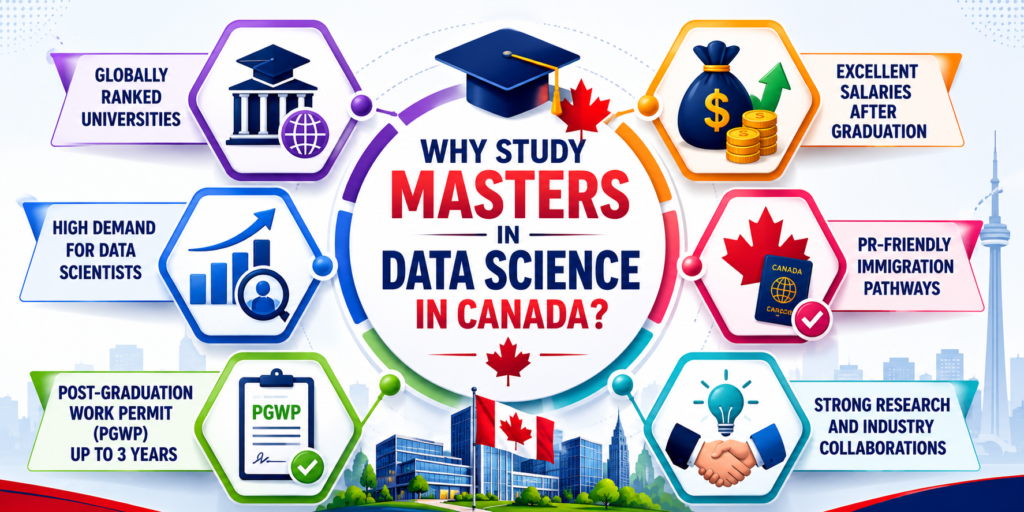
There are many reasons why students choose MS in Data Science in Canada:
Canada is one of the most attractive countries for international graduates due to its education quality and career prospects.
Top Universities for Masters in Data Science in Canada 2026-27
| University | Program | Approx. Tuition Fee (CAD) | Intake |
| University of Toronto | MSc Applied Computing / Data Science | $35,000 – $50,000 | Fall |
| University of British Columbia | Master of Data Science | $40,000 – $55,000 | Fall |
| University of Waterloo | Master of Data Science | $25,000 – $40,000 | Fall |
| Western University | Master of Data Analytics | $25,000 – $45,000 | Fall |
| Queen’s University | Master of Data Analytics | $30,000 – $50,000 | Fall |
| McGill University | MSc Data Science | $20,000 – $35,000 | Fall |
| University of Calgary | MSc Data Science | $20,000 – $35,000 | Fall |
| University of Alberta | MSc Computing Science | $15,000 – $30,000 | Fall |
The tuition fee for Masters in Data Science in Canada generally ranges between CAD 20,000 and CAD 50,000 depending on the institution and course type.
Eligibility for Masters in Data Science in Canada
To apply for Masters in Canada for Data Science, students generally need:
- Academic Requirements
- Minimum GPA
Most universities require:
- English Language Requirements
GRE is optional for several universities but may strengthen your application.
Masters in Data Science in Canada Fees
The cost of pursuing Masters in Data Science in Canada 2026-27 depends on the university and city.
- Average Tuition Fee
- Living Expenses
Students should budget:
Average annual living expenses range from CAD 20,000 to CAD 30,000.
Application Deadlines for 2026-27
The exact deadlines vary by university, but students should apply early.
| Intake | Application Window | Key Characteristics |
| Fall 2026 (Primary) | September 2025 – January 2026 | The largest intake window. Offers the widest selection of courses (undergraduate and postgraduate) and maximum scholarship options. |
| Winter 2027 (Secondary) | June 2026 – November 2026 | Offers lower competition and standard living/accommodation options, though available at a limited number of mid-tier universities (mostly for Master’s programs). |
| Fall 2027 (Next Cycle) | September 2026 onwards | Applications open a full year in advance via UCAS for undergraduate programs or direct portals for postgraduate applications. |
Most universities open applications nearly one year in advance.
Scholarships for International Students
Many universities offer scholarships for MS in Data Science in Canada:
Some scholarships can cover tuition fees partially or fully.
Career Opportunities After MS in Data Science
Graduates can work as:
The average salary for Data Science professionals in Canada ranges from CAD 65,000 to CAD 95,000 annually and may increase significantly with experience.
Why Choose Rajveer Chahal Education Consultant?
Choosing the right university can be challenging. Rajveer Chahal Education Consultant helps students with:
Final Thoughts
Pursuing a Masters in Data Science in Canada 2026-27 is an excellent investment for students seeking global career opportunities. With top-ranked universities, excellent salaries, research opportunities, and pathways to Canadian PR, Canada remains one of the best destinations for Data Science education.
If you are planning your study abroad journey, Rajveer Chahal Education Consultant can help you choose the right university and successfully achieve your dream of studying in Canada.
Related Blogs:
1. Which are the best universities for Masters in Data Science in Canada 2026-27?
The top universities for Masters in Data Science in Canada 2026-27 include the University of Toronto, University of British Columbia (UBC), University of Waterloo, McGill University, University of Alberta, Western University, Queen’s University, and the University of Calgary. These universities are globally recognized for their academic excellence and research opportunities.
2. What is the average tuition fee for MS in Data Science in Canada?
The tuition fee for MS in Data Science in Canada generally ranges from CAD 20,000 to CAD 50,000 per year, depending on the university, program duration, and course structure.
3. What are the eligibility requirements for Masters in Data Science in Canada?
Students usually need:
4. What are the application deadlines for Masters in Data Science in Canada 2026-27?
Most universities accept applications for the Fall 2026 intake between September 2025 and January 2026. However, deadlines vary by institution, so students should check the official university websites for exact dates.
5. Is MS in Data Science in Canada for Indian students a good option?
Yes. Canada offers world-class education, excellent job opportunities, post-study work permits of up to three years, and immigration-friendly policies, making it one of the best destinations for Indian students pursuing Data Science.
6. Are scholarships available for Masters in Canada for Data Science?
Yes. International students can apply for various scholarships, including:
Many scholarships partially or fully cover tuition fees.
7. What are the career opportunities after completing Data Science courses in Canada?
Graduates can pursue careers as:
These roles are in high demand across Canada.
8. What is the average salary after Masters in Data Science in Canada?
The average salary for Data Science professionals in Canada ranges from CAD 65,000 to CAD 95,000 per year. With experience and specialization, professionals can earn significantly higher salaries.
9. Can I get Permanent Residency (PR) after completing Masters in Data Science in Canada?
Yes. After graduation, students can obtain a Post-Graduation Work Permit (PGWP), gain Canadian work experience, and apply for Permanent Residency through programs such as Express Entry and Provincial Nominee Programs (PNPs).
10. Why should I choose Rajveer Chahal Education Consultant for studying Data Science in Canada?
Rajveer Chahal Education Consultant provides complete guidance for students, including university shortlisting, profile evaluation, SOP and LOR assistance, scholarship guidance, application support, Canada study visa assistance, and pre-departure services to help students achieve their study abroad goals successfully.