

Canada remains one of the most sought-after destinations for visitors, students, and immigrants worldwide. However, receiving a refusal letter after investing time, money, and effort into your application can be frustrating. According to immigration expert Rajveer Chahal, many applicants focus only on submitting documents without fully understanding how visa officers assess an application.
If your Canada Visa Rejected status has left you disappointed, you’re not alone. Many applicants face this situation every year due to weak documentation, unclear travel purpose, financial concerns, or lack of strong home-country ties.
A Canada Visa Rejected decision does not always mean your dream is over. In many cases, applicants receive approval later after correcting mistakes, improving documentation, and presenting a stronger explanation.
In this guide, Rajveer Chahal shares important lessons, common mistakes, and practical strategies that can help applicants understand Canada visa refusal reasons and build a stronger application in 2026.
Key Insight: A Canada visa rejection is not always the end of your journey. Most refusals happen because the application did not create enough confidence for the visa officer through documents, explanation, and overall profile strength.
Team Rajveer Chahal
A Canada Visa Refusal Is Not the End
One of the biggest lessons many applicants learn is that a visa refusal is not a permanent ban.
A refusal simply means the visa officer was not fully convinced based on the information available during the assessment. Many applicants successfully receive approvals after addressing the concerns raised in their refusal letters.
A Canada Visa Rejected decision should not be treated as a final failure. Instead, applicants should carefully review the refusal reasons, improve weak areas, and prepare a stronger application before reapplying.
Instead of viewing a refusal as a failure, consider it an opportunity to identify weaknesses and improve your application.
Important: Visitor visa refusal rates can vary depending on the applicant’s country, profile, and documentation.
Team Rajveer Chahal
Understanding Why Canada Visas Get Refused
The first step after receiving a refusal is understanding the actual reason behind it.
Many applicants search online asking, “Why was my Canada visa rejected?” The answer usually lies within the refusal letter.
When applicants receive a Canada Visa Rejected letter, the most important step is to understand the officer’s concern instead of submitting the same application again.
Visa officers assess applications based on:
Understanding these factors can help you avoid making the same mistakes again.
ALSO READ:SOP Tips That Increase Your Canada Visa Approval Chances
Lesson #1: Financial Proof Matters More Than You Think
One of the most common Canada visa refusal reasons is insufficient financial evidence.
In many Canada Visa Rejected cases, financial documents are present but not properly explained. Visa officers need clear proof of income source, financial stability, and ability to afford the trip or study plan.
Many applicants submit bank statements showing available funds but fail to explain:
Visa officers need confidence that applicants can financially support themselves during their stay in Canada.
What I Learned
Instead of simply showing money in the bank, applicants should provide:
Strong financial documentation helps establish credibility.
Lesson #2: A Clear Purpose of Visit Is Essential
Another major reason for Canada visitor visa rejection is an unclear travel purpose.
Many applicants submit generic invitation letters or vague travel plans. For example:
“I want to visit Canada for tourism.”
This statement alone may not convince an officer.
A stronger application should include:
What I Learned
The more specific your purpose, the stronger your application becomes.
Lesson #3: Travel History Plays a Bigger Role Than Expected
Travel history often influences visa decisions. Applicants who have successfully visited and returned from countries such as:
may have stronger profiles.
This does not mean applicants without travel history cannot be approved. However, limited travel history may require stronger supporting evidence in other areas.
Lesson #4: Employment Documents Must Be Strong
A weak employment profile often leads to Canada visa refusal reasons related to economic establishment.
Officers want evidence that applicants have reasons to return home.
Important documents include:
What I Learned
A simple employment letter is often not enough. Applicants should demonstrate:
Lesson #5: Family Ties Can Influence Decisions
One factor many applicants underestimate is family ties.
Visa officers assess both family ties in Canada and family ties in the home country.
| Family Ties in Canada | Family Ties in Home Country |
|---|---|
| Spouse | Elderly parents |
| Parents | Dependents |
| Siblings | Spouse |
| Children | Property ownership |
| Other relatives | Family responsibilities |
Strong home-country ties can reassure officers that applicants intend to return after their authorized stay.
Lesson #6: Incomplete Applications Can Lead to Refusal
Many applicants assume officers will request missing documents. In reality, officers often make decisions based on the information already submitted.
Common mistakes include:
What I Learned
Every document should support a specific aspect of the application. Think of your application as a complete story rather than a collection of papers.
Key Warning: Submitting the same weak application again without addressing refusal concerns can increase the chances of another rejection.
Team Rajveer Chahal
Most Common Canada Visa Refusal Reasons
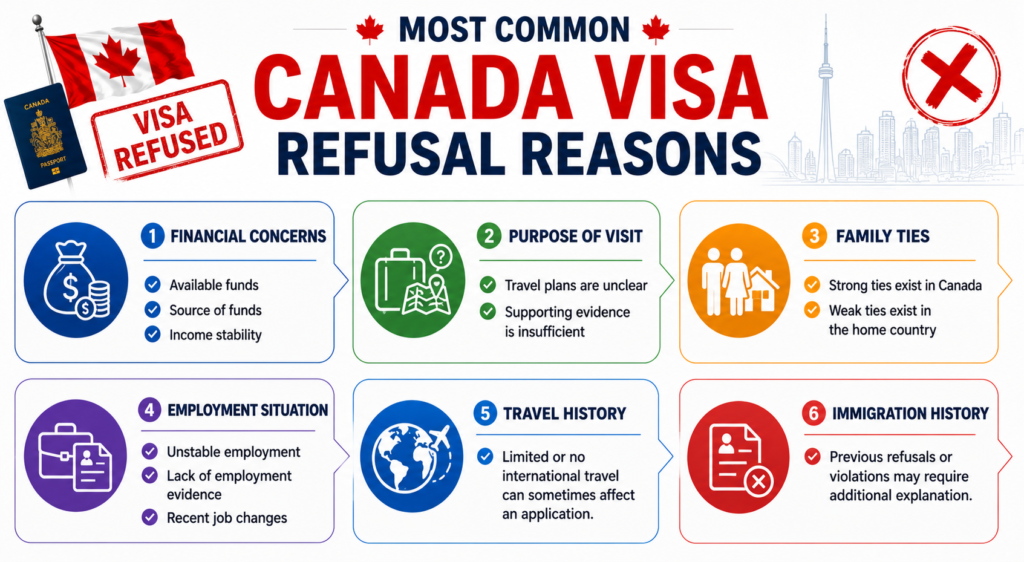
Below are some of the most frequently cited Canada visa refusal reasons:
| Refusal Reason | Common Officer Concern |
|---|---|
| Financial Concerns | Available funds, source of funds, or income stability may not be clear |
| Purpose of Visit | Travel plans may appear unclear or unsupported |
| Family Ties | Strong ties in Canada or weak ties in the home country may raise concerns |
| Employment Situation | Unstable employment, lack of evidence, or recent job changes may weaken the profile |
| Travel History | Limited or no international travel can sometimes affect application confidence |
| Immigration History | Previous refusals or violations may require additional explanation |
What To Do After Canada Visa Rejection
If you’re wondering what to do after Canada visa rejection, follow these steps:
After a Canada Visa Rejected outcome, applicants should not rush into reapplying. A successful reapplication depends on fixing the exact issues mentioned in the refusal letter.
Step 1: Read the Refusal Letter Carefully
Identify the exact concerns raised by the visa officer.
Step 2: Review Your Documents
Look for gaps in finances, employment, travel plans, and family ties.
Step 3: Strengthen Weak Areas
Address every concern before submitting a new application.
Step 4: Prepare a Strong Explanation
Provide additional context and evidence where needed.
Step 5: Reapply Strategically
Avoid submitting the same application without improvements.
ALSO READ:Can Average Students Get Canada Visa? Truth Revealed
How to Reapply After Canada Visa Rejection
Many applicants ask about how to reapply after Canada visa rejection. The process should include stronger evidence and better explanation.
To overcome a Canada Visa Rejected result, your new application should include updated documents, stronger explanations, and evidence that directly addresses the previous refusal concerns.
Updated Financial Documents
Provide stronger evidence of financial stability, income consistency, and source of funds.
Better Supporting Documentation
Include documents such as:
Stronger Travel Plan
Clearly explain:
Detailed Letter of Explanation
Address each refusal concern individually and explain how the new application is stronger than the previous one.
How to Avoid Canada Visa Rejection in 2026
If you’re preparing a new application, understanding how to avoid Canada visa rejection in 2026 can improve your chances.
Realization: Approval Is About Confidence
Perhaps the most important lesson learned after a Canada Visa Rejected experience is this:
Visa officers do not approve applications simply because someone wants to visit, study, or immigrate. They approve applications when the evidence creates confidence.
Every document should help answer questions such as:
When these questions are answered effectively, approval chances improve significantly.
A Canada Visa Rejected decision can be improved when the applicant submits a more complete, honest, and well-organized application with strong supporting proof.
Final Thoughts
Receiving a Canada Visa Rejected decision can be discouraging, but it also provides valuable insight into how the immigration process works. Understanding Canada visa refusal reasons, strengthening weak areas, and learning how to reapply after Canada visa rejection can dramatically improve future applications.
As Rajveer Chahal often advises applicants, a refusal should be viewed as feedback rather than failure. By carefully reviewing the officer’s concerns, improving documentation, and presenting a stronger overall profile, many applicants successfully achieve their Canadian goals on their next attempt.
Whether you’re facing a Canada visitor visa rejection, a Canada study visa refusal, or another type of refusal, the lessons learned today can become the foundation of a stronger application tomorrow.
Final Insight: Canada visa refusal should be treated as feedback. Once you understand the officer’s concerns and improve your documents, explanation, and profile strength, your next application can become much stronger.
Team Rajveer Chahal
Need Help After Canada Visa Rejection?
Reach out to Rajveer Chahal Education Consultant today for professional guidance on refusal analysis, documentation improvement, and reapplication strategy.
Call: 7508361111 or 7068161111
Contact us for more details and further assistance.
Related Articles
Frequently Asked Questions (FAQs)
1. Why was my Canada visa rejected?
Canada visas are commonly refused due to financial concerns, weak travel history, insufficient documentation, unclear purpose of visit, or concerns about returning to the home country.
2. Does a visa refusal affect future applications?
A refusal does not permanently prevent approval, but future applications must address the previous concerns clearly and provide stronger supporting evidence.
3. Can I reapply immediately after a Canada visa rejection?
Yes, but it is advisable to strengthen your application before reapplying. Submitting the same documents again without improvements may lead to another refusal.
4. What are the most common Canada visa refusal reasons?
Purpose of visit, financial status, family ties, employment situation, travel history, and incomplete documentation are among the most common refusal reasons.
5. Should I submit the same documents again?
No. You should identify the refusal reasons and provide stronger supporting evidence, updated documents, and a clear explanation addressing previous concerns.
6. How can I improve my chances of approval?
Provide complete documentation, stronger financial evidence, a clear purpose of travel, proof of home-country ties, and a well-structured letter of explanation.
7. Can travel history affect my Canada visa application?
Yes. A strong travel history may strengthen your application profile because it can show previous compliance with visa rules and return history.
8. Is a Canada visitor visa rejection permanent?
No. Many applicants are approved after submitting a stronger application that properly addresses the refusal concerns.
9. How long should I wait before reapplying?
There is no mandatory waiting period, but reapplying without addressing refusal concerns may lead to another rejection. It is better to reapply only after improving your profile.
10. Can professional guidance help after a visa refusal?
Yes. Reviewing refusal reasons with an experienced immigration professional can help identify weaknesses and improve future applications.